

International Teaching Career for Indian Teachers: 2026 Guide

An international teaching career for Indian teachers is defined as full-time employment in an overseas school, language institute, or cultural center using globally recognized credentials and cross-cultural teaching skills. Countries like the UAE, UK, Singapore, and Canada are actively hiring Indian educators for their strong subject knowledge, English proficiency, and familiarity with CBSE, IB, British, and American curricula. The financial upside is real: tax-free salaries in the UAE, structured visa pathways in the UK, and scholarship programs like Fulbright TEA and British Council TESOL make this a career move worth planning carefully.
What qualifications do indian teachers need to teach abroad?
The standard industry term for this credential set is “internationally portable teaching qualifications.” Most countries require a combination of academic degrees, subject-specific licenses, and language teaching certifications before they will sponsor a work visa.
Degree requirements form the foundation. A Bachelor’s degree in Education (B.Ed) or a subject-specific degree with a teaching license is the minimum for most international school roles. Some countries, particularly the UK and Singapore, prefer candidates with a Master’s degree or a postgraduate teaching qualification.

Language teaching certifications open a separate and large job market. For ESL roles at language institutes, TEFL, TESOL, or CELTA are the recognized credentials. CELTA, awarded by Cambridge Assessment English, carries the most weight globally and is accepted in over 54 countries.
Country-specific licensing adds another layer. The UK requires Indian teachers to apply for Qualified Teacher Status (QTS) through the Teaching Regulation Agency. The UK Skilled Worker Visa requires a job offer from a licensed school and a minimum salary of £30,960 per year, with priority given to STEM and Special Educational Needs (SEN) subjects. The UAE requires registration with the Knowledge and Human Development Authority (KHDA) in Dubai or the Abu Dhabi Department of Education and Knowledge (ADEK).
Key credentials to build before applying:
- B.Ed or subject degree plus a recognized teaching license
- TEFL, TESOL, or CELTA for ESL and language center roles
- Postgraduate teaching qualification (PgCTL or equivalent) for international school roles
- Country-specific registration (QTS for UK, KHDA/ADEK for UAE)
Two scholarship programs stand out for professional development. The Fulbright TEA Program selects 2 Indian teachers annually for a six-week fellowship in the United States. The British Council offers 20 scholarships each year for Indian government school educators to complete an MSc TESOL online with the University of Stirling. Both programs add significant weight to an international application.
Pro Tip: Start your QTS application or CELTA course at least 12 months before your target move date. Processing times and course availability can push timelines back significantly.
Which countries offer the best salaries for indian teachers?
The best overseas teaching destinations for Indian educators in 2026 are the UAE, UK, Singapore, Canada, and select Southeast Asian countries including Thailand and South Korea. Each market differs on salary, visa ease, and the type of credentials it values most.
The UAE is the top destination for salary and benefits. UAE schools offer tax-free income, employer-sponsored work visas, housing allowances, health insurance, and annual airfare. Monthly salaries range from AED 4,000 to AED 8,000, which is approximately ₹90,000 to ₹1.8 lakh per month. That figure is tax-free, which means the real purchasing power is significantly higher than an equivalent Indian salary.
The UK offers structured career growth and a path to permanent residency. The Skilled Worker Visa sets a salary floor of £30,960 per year, and experienced teachers in London can earn considerably more. The UK also has a formal pay scale for teachers, which means your salary increases are predictable.
Singapore pays among the highest salaries in Asia for qualified teachers, with monthly salaries for experienced educators reaching SGD 5,000–7,000. Canada offers strong job security and a clear route to permanent residency through provincial nominee programs.
| Country | Avg. Monthly Salary | Tax-Free | Visa Ease | Top Credential Needed |
|---|---|---|---|---|
| UAE | AED 4,000–8,000 | Yes | Moderate | B.Ed + subject license |
| UK | £2,580+ | No | Moderate | QTS + Skilled Worker Visa |
| Singapore | SGD 3,500–7,000 | No | Competitive | Degree + strong experience |
| Canada | CAD 4,000–6,500 | No | Moderate | Provincial certification |
| Thailand | THB 40,000–70,000 | No | Easy | TEFL/TESOL |
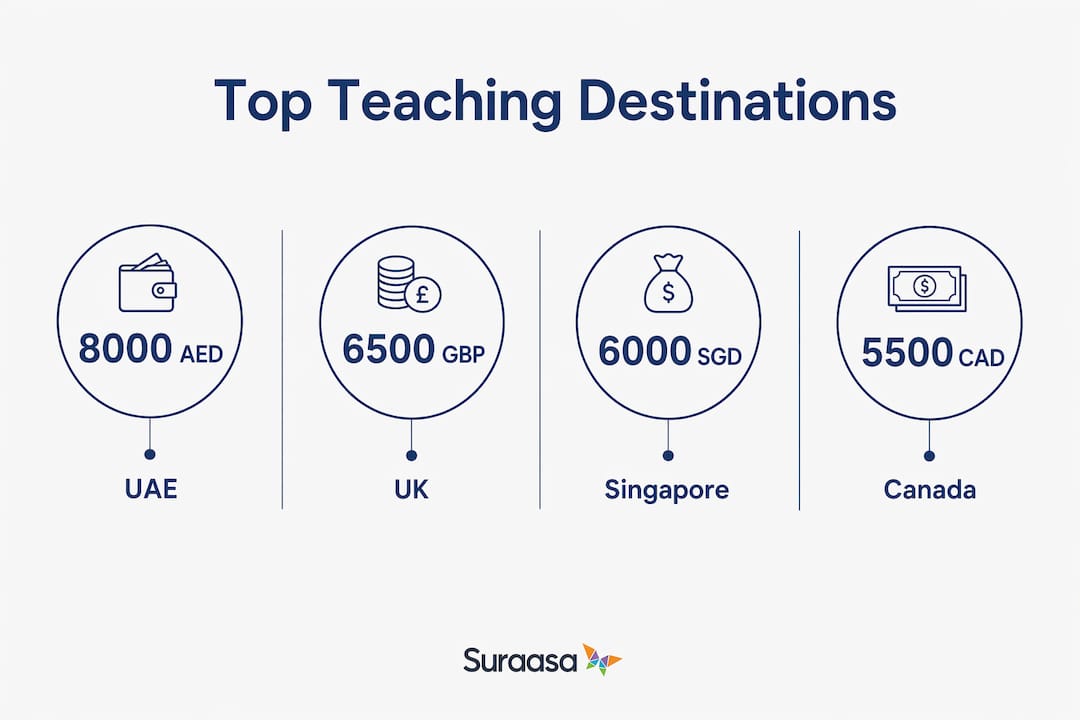
Pro Tip: If you want tax-free income and fast visa processing, target UAE first. If long-term residency and career structure matter more, the UK or Canada is a better fit.
How do international schools differ from language institutes?
International teaching is not a single category. The two main environments, international schools and language institutes, require different credentials, offer different salaries, and lead to very different career paths. Choosing the wrong track wastes time and money.
International schools follow Western curricula such as the International Baccalaureate (IB), British National Curriculum, or American Common Core. Teachers in these schools are subject specialists. A math teacher teaches math. A science teacher teaches science. Salaries are higher, job security is stronger, and the professional development opportunities are more structured. These roles typically require a B.Ed, subject expertise, and often a postgraduate teaching qualification.
Language institutes focus almost entirely on English as a Second Language (ESL) instruction. The student body is adult learners or school-age children learning English as an additional language. TEFL or CELTA is the primary credential. Salaries are lower than international schools, but entry requirements are easier to meet. This track suits teachers who want to move abroad quickly and build experience before transitioning to a school role.
A third, less-discussed option is cultural teaching through the Indian Council for Cultural Relations (ICCR). The ICCR deploys Indian teachers to embassies and cultural centers worldwide on fixed two-year contracts to teach subjects like Yoga, Hindi, and Performing Arts. This path suits teachers with specialized cultural expertise and offers a government-backed route to international experience.
Key differences at a glance:
- International schools: Higher salary, subject-specific roles, IB or British/American curriculum, requires B.Ed and often a postgraduate qualification
- Language institutes: Lower entry barrier, ESL focus, TEFL/CELTA required, faster to enter but slower salary growth
- ICCR cultural centers: Government-backed, two-year contracts, specialized in Indian cultural subjects, suited for niche expertise
What are the steps to secure an overseas teaching job?
Getting an overseas teaching job as an Indian educator follows a clear process. The steps below reflect how most successful placements actually happen, not just what job boards recommend.
-
Update your CV for an international audience. An Indian resume format does not work abroad. Remove photos, date of birth, and marital status. Lead with a professional summary, then list your qualifications, certifications, and measurable outcomes. Resources like career-change resume guides can help you reframe your Indian teaching experience for a global hiring manager.
-
Build a teaching portfolio. Include lesson plans, student outcome data, and any curriculum development work. International schools, especially IB schools, want evidence of your teaching philosophy and results.
-
Use the right job search channels. Recruitment agencies like Teachanywhere, Search Associates, and TES (Times Educational Supplement) list thousands of international school vacancies. For UAE roles, platforms like Bayt and GulfTalent are widely used. Apply directly to school websites for the best results.
-
Prepare for virtual interviews. Most international schools conduct first-round interviews over Zoom or Microsoft Teams. Research the school’s curriculum, know your subject benchmarks, and prepare a short demo lesson.
-
Understand visa and contract terms. The standard process involves CV submission, agency screening, virtual interview, contract signing, and employer-sponsored visa processing. Read every contract clause, especially around housing allowances, notice periods, and return airfare.
-
Develop cross-cultural competence. Schools in the UAE, Singapore, and Southeast Asia serve highly diverse student populations. Demonstrating cultural awareness in your application and interview gives you a real edge over candidates who treat it as an afterthought.
Pro Tip: Join LinkedIn groups for international school teachers and follow school principals in your target country. Many international teaching jobs are filled through referrals before they are ever posted publicly.
Key takeaways
Building an international teaching career as an Indian educator requires the right credentials, a targeted job search strategy, and a clear understanding of which global markets match your qualifications and goals.
| Point | Details |
|---|---|
| Credentials come first | Secure B.Ed, TEFL/CELTA, or QTS before applying to avoid automatic rejection. |
| UAE leads on salary | Tax-free monthly pay of AED 4,000–8,000 plus housing and airfare makes UAE the top financial destination. |
| Know your teaching track | International schools and language institutes require different credentials and offer different career paths. |
| Use targeted job channels | Agencies like Search Associates and TES, plus direct school applications, outperform generic job boards. |
| Scholarships reduce cost | British Council and Fulbright TEA programs fund professional development for Indian educators each year. |
What i’ve learned helping indian teachers go global
Most Indian teachers underestimate how transferable their skills actually are. Years of managing large classrooms, teaching across mixed-ability groups, and covering a demanding curriculum like CBSE builds a level of subject depth and classroom resilience that international schools genuinely value.
The challenge is not competence. It is presentation. I’ve seen highly qualified teachers get passed over because their CV read like a government form, or because they couldn’t articulate their teaching philosophy in an interview. International schools hire for fit and clarity, not just credentials.
The other thing I’d push back on is the idea that you need to wait until everything is perfect before applying. You don’t. Apply with what you have, get feedback from rejections, and keep building. The teachers who move abroad fastest are not always the most qualified. They are the most prepared.
One more thing: cultural intelligence is not a soft skill you can fake. If you’re serious about teaching in the UAE, Singapore, or Southeast Asia, spend real time learning about the local education culture, not just the visa process. Schools notice the difference immediately.
— Ankit
How Suraasa helps you build an international teaching career
If you’re ready to move from planning to action, Suraasa offers a direct path. Suraasa’s flagship program, PgCTL, is a UK-accredited postgraduate qualification built specifically for teachers aiming at international school roles. It covers pedagogy, curriculum design, and professional practice at a level that meets hiring standards in the UAE, UK, and beyond.

Beyond certification, Suraasa provides career mentoring, job placement support, and access to a network of schools across 50+ countries. Whether you’re targeting your first overseas role or moving up to a senior position, explore Suraasa’s programs to see which qualification fits your current stage and target market.
FAQ
What qualifications do indian teachers need to teach abroad?
Most international teaching roles require a B.Ed or subject degree, a recognized teaching license, and in many cases a TEFL, TESOL, or CELTA certification for ESL roles. Country-specific credentials like UK QTS or UAE KHDA registration are also required for those markets.
Which country is best for indian teachers seeking overseas jobs?
The UAE is the top destination for salary and benefits, offering tax-free monthly pay of AED 4,000–8,000 plus housing and airfare allowances. The UK and Canada are better choices if long-term residency and structured career growth are the priority.
How do i apply for teaching jobs abroad as an indian teacher?
The standard process involves updating your CV for an international format, applying through recruitment agencies like Search Associates or TES, attending virtual interviews, signing a contract, and completing employer-sponsored visa processing.
Are there scholarships for indian teachers to study for international certifications?
Yes. The British Council offers 20 scholarships annually for Indian government school educators to complete an MSc TESOL with the University of Stirling. The Fulbright TEA Program selects 2 Indian teachers per year for a six-week fellowship in the United States.
What is the difference between teaching at an international school and a language institute?
International schools follow IB, British, or American curricula and hire subject specialists with B.Ed qualifications and higher salaries. Language institutes focus on ESL instruction, require TEFL or CELTA, and have lower entry requirements but slower salary growth.

 Confidential & Free of Cost
