

The Role of Continuing Education for Teachers

Continuing education for teachers is defined as the structured, ongoing process of professional learning that upgrades pedagogical knowledge, classroom skills, and teaching practices throughout a career. Known formally as continuous professional development (CPD), it covers everything from accredited courses and workshops to peer collaboration and digital learning platforms. UNESCO frames lifelong learning not as an optional add-on but as a core part of a teacher’s professional identity. The research is clear: teachers who invest in CPD teach more effectively, experience less workplace stress, and produce measurably better student outcomes.
What is the role of continuing education for teachers?
The role of continuing education for teachers is to keep their knowledge and skills aligned with what students actually need in the classroom. Teaching is not a static profession. Curriculum standards shift, student demographics change, and new instructional technologies emerge every few years. CPD gives teachers the tools to respond to those changes without losing instructional quality.
UNESCO’s 2026 report positions teachers as both lifelong learners themselves and as facilitators of lifelong learning in their students. This dual role matters because a teacher who stops learning sends an unspoken message to students that learning has a finish line. When teachers model curiosity and growth, classrooms become more engaged environments.
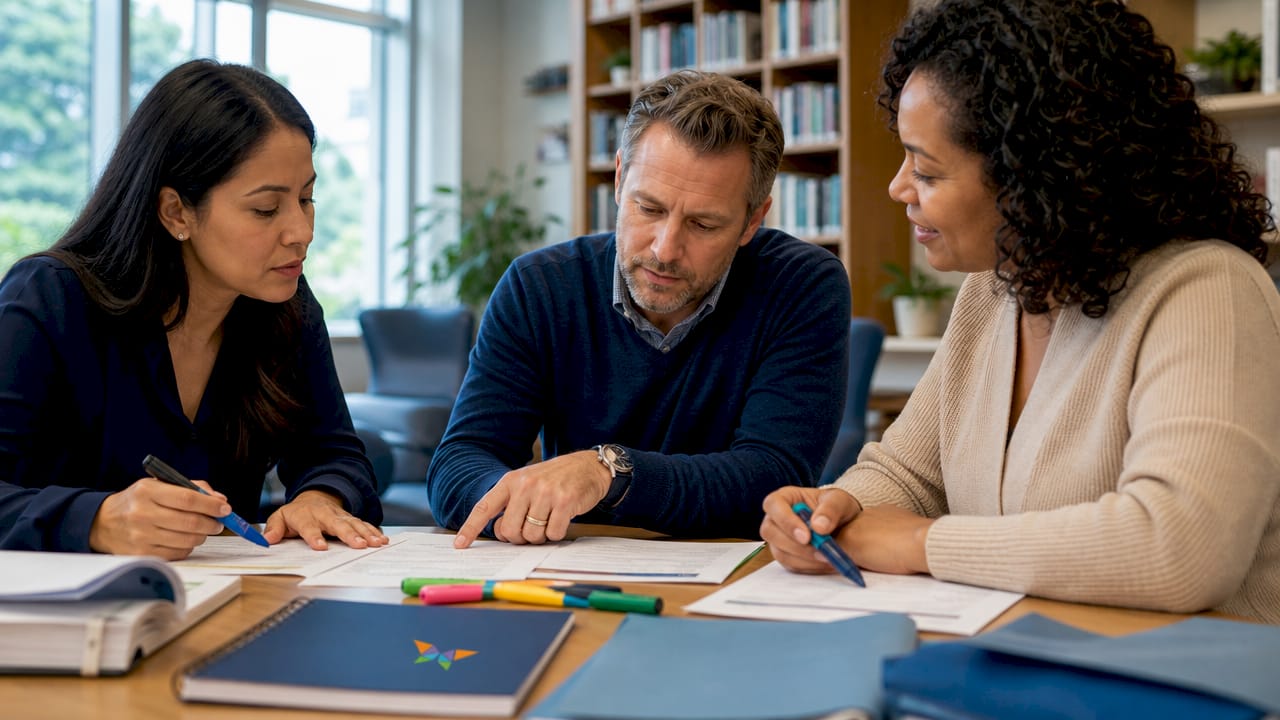
Professional development for educators takes many forms. Formal routes include university courses, certification programs, and accredited workshops. Informal routes include peer observation, reading current research, and using tools like Grammarly or Hemingway Editor to sharpen written communication for lesson planning and parent correspondence. The combination of formal and informal learning is what builds a well-rounded professional.
The importance of teacher training also extends to career advancement. Teachers with stronger pedagogical credentials qualify for leadership roles, international placements, and higher salary brackets. CPD is not just about being a better teacher today. It is about building a career that stays relevant and rewarding over decades.
How does continuing education improve teaching skills?
Continuing education directly strengthens what researchers call general pedagogical knowledge (GPK): the understanding of how students learn, how to structure lessons, and how to manage a classroom effectively. The OECD Teacher Knowledge Survey found that teachers with higher GPK scores spend more time on actual instruction and report significantly less stress when adapting to new demands. That is a concrete, measurable return on professional development investment.
The benefits of teacher workshops and structured courses show up in specific classroom behaviors. A 2026 study from Chile examined math teachers who completed targeted PD programs and found measurable growth in what researchers call teacher noticing: the ability to perceive what is happening in a lesson, interpret student responses accurately, and make better real-time decisions. These are not abstract skills. They determine whether a student who is struggling gets the right intervention at the right moment.
Research from Rwanda reinforces this picture. A 2026 CPD study found that teachers who participated in structured professional development reported gains in inquiry-based learning techniques, ICT integration, and student-centered teaching approaches. These are exactly the skills that modern classrooms require.
Here is what improving your teaching skills through CPD looks like in practice:
- Pedagogical knowledge: Courses in learning theory, assessment design, and differentiated instruction build the foundation for better lesson quality.
- Subject-specific depth: Discipline-focused workshops sharpen content knowledge, which directly reduces the time teachers spend on preparation.
- Technology integration: Training in platforms like Google Classroom, Kahoot, or Nearpod helps teachers use digital tools purposefully rather than reactively.
- Classroom management: Structured PD on behavior management reduces disruptions and increases instructional time.
- Reflective practice: Programs that include observation and feedback cycles help teachers identify blind spots they cannot see on their own.
Pro Tip: When selecting a professional development course, match it to one specific gap in your teaching practice rather than choosing broadly. If your students underperform on assessments, prioritize a course on formative assessment design. Targeted PD produces faster, more visible results than general skill-building.
What evidence links teacher PD to better student outcomes?
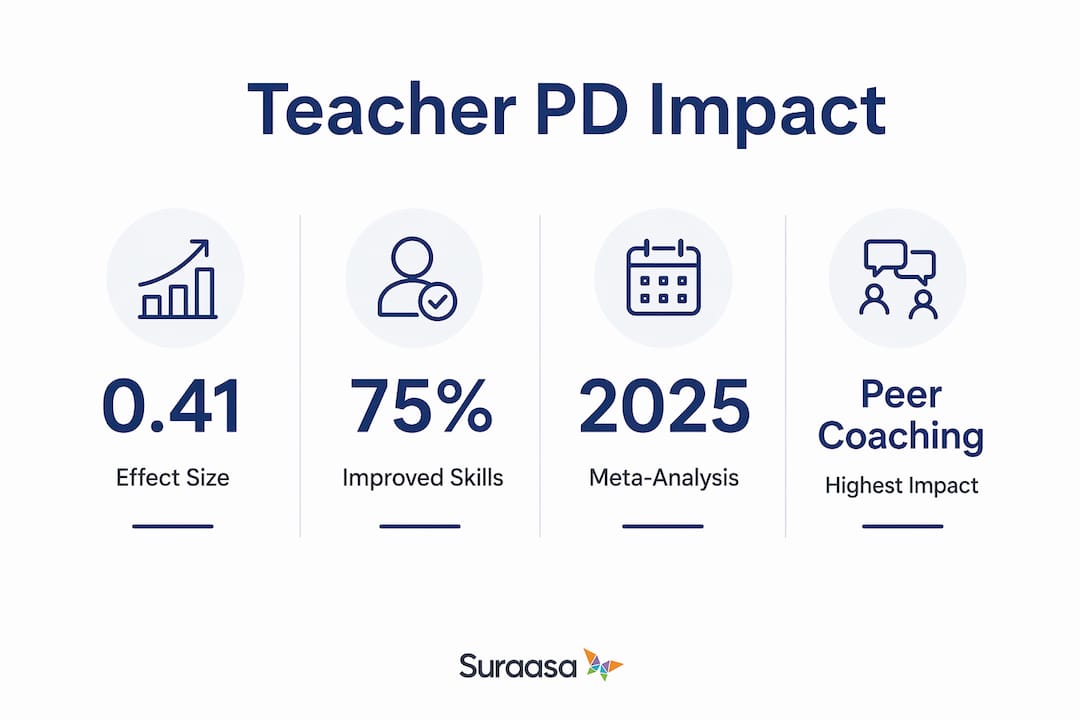
The impact of ongoing education on student achievement is well-documented and statistically significant. A 2025 meta-analysis from the University of Twente synthesized data from 27 studies and found that professional development focused on data use produced a medium-sized positive effect on student achievement, with an effect size of g = 0.41. An effect size at that level is educationally meaningful. It represents the difference between a student performing at the 50th percentile and performing at the 66th percentile.
The Chile study on mathematics PD adds a qualitative layer to that data. Teachers who developed stronger noticing skills made better instructional decisions mid-lesson, which translated directly into improved student comprehension. The mechanism is clear: better-trained teachers catch learning gaps earlier and respond more precisely.
The table below summarizes what the research shows across different PD types and their measured outcomes.
| PD type | Measured outcome | Source |
|---|---|---|
| Data-use focused PD | Effect size g = 0.41 on student achievement | University of Twente meta-analysis |
| Math-specific PD (teacher noticing) | Improved perception, interpretation, and decision-making in lessons | Chile 2026 study |
| CPD with ICT and inquiry-based learning | Gains in learner-centered teaching methods | Rwanda 2026 CPD study |
| Higher education qualifications | Higher GPK scores, better instructional use of class time | OECD Teacher Knowledge Survey |
One critical nuance from the University of Twente research: PD design and school context significantly affect whether gains transfer to students. Interventions that align with school routines and include implementation supports produce higher effect sizes than standalone workshops. This means the quality and structure of PD matters as much as participation in it.
What challenges do teachers face with continuing education?
The Rwanda CPD study surfaces a problem that many teachers recognize from experience: awareness without transfer. Teachers can complete a workshop, report new knowledge, and still return to the same classroom habits. The Rwanda study found that while teachers reported gains in inquiry-based and ICT-integrated teaching, observed lessons still showed incomplete application, particularly in lesson planning and assessment design.
This gap exists for predictable reasons. A single workshop does not change deeply ingrained habits. Without follow-up coaching, feedback cycles, and school-level support structures, new knowledge fades before it becomes practice. The problem is not teacher motivation. It is the absence of the conditions that make transfer possible.
Effective CPD requires more than attendance. It requires a system around the learning. Schools that build collaborative cultures, where teachers observe each other, share lesson plans, and debrief regularly, see far better transfer rates than schools that treat PD as a one-time event. The OECD data on higher education qualifications reinforces this: bachelor’s and master’s degree holders show higher GPK scores, suggesting that sustained, structured learning builds deeper competence than short-term exposure.
Pro Tip: Before enrolling in any PD program, ask whether it includes post-training coaching or peer accountability structures. Programs that build in follow-up support produce significantly better results than those that end at the final session. Check for online professional development courses that include mentoring or cohort-based learning as part of the design.
How can teachers get the most from continuing education?
Getting real value from CPD requires a deliberate approach. Passive participation in workshops rarely produces lasting change. Here is a practical sequence for making continuing education work for your career and your classroom:
-
Audit your current practice. Before choosing any program, identify one or two specific areas where your teaching falls short. Use student performance data, peer feedback, or self-recorded lessons to locate the gap. This prevents you from spending time on PD that does not address your actual needs.
-
Match the format to the goal. Formal courses and certification programs work best for building foundational knowledge or earning credentials for career advancement. Peer collaboration and lesson study groups work best for refining specific classroom techniques. Informal learning through reading journals like Educational Researcher or Teaching and Teacher Education keeps you current between formal programs.
-
Apply within two weeks. Research on skill transfer shows that new knowledge applied quickly is far more likely to stick. After any workshop or course module, design one lesson that uses the new technique and teach it within two weeks of completing the session.
-
Seek feedback on the application. Ask a colleague to observe the lesson or record it yourself. Reflection without external input misses the blind spots that CPD is supposed to address. Platforms that include training and development courses with built-in feedback mechanisms accelerate this cycle significantly.
-
Track credentials and continuing education requirements. Many states and international school systems require teacher certification renewal on a set schedule. Keep a record of completed hours, certifications earned, and skills developed. This documentation matters for promotions, international applications, and license renewals.
-
Use digital platforms for flexibility. Online educator training programs allow you to complete coursework around a full teaching schedule. Platforms offering globally recognized qualifications, such as UK-accredited certifications, expand your career options beyond your current school system or country.
Key takeaways
Continuing education is the single most reliable mechanism teachers have for improving both their instructional quality and their long-term career outcomes.
| Point | Details |
|---|---|
| CPD builds pedagogical knowledge | Higher GPK scores link directly to better student achievement and reduced teacher stress, per OECD data. |
| PD design determines outcomes | A 2025 meta-analysis shows effect size g = 0.41 only when PD aligns with school routines and includes implementation support. |
| Awareness without transfer is a real risk | Rwanda research shows teachers can report gains without changing classroom practice if follow-up support is absent. |
| Teacher noticing is a measurable skill | Chile’s 2026 study shows targeted PD improves perception, interpretation, and real-time decision-making in lessons. |
| Formal credentials expand career options | Higher education qualifications correlate with stronger GPK and open pathways to international and leadership roles. |
Why I think most teachers underestimate what CPD can do for them
Most teachers I have spoken with treat professional development as a compliance requirement. They attend the mandated hours, collect the certificate, and move on. That framing misses the point entirely.
The teachers who benefit most from CPD are the ones who treat it as a diagnostic tool. They use it to answer a specific question about their own practice. Why are my students not retaining this concept? Why does my classroom management break down in the last period? That kind of targeted learning produces results that generic workshops never will.
What the research from Chile and Rwanda makes clear is that teaching competence is not fixed. The teacher noticing framework, the ability to read a room and adjust in real time, is a trainable skill. That should be genuinely motivating. It means the ceiling on your effectiveness as a teacher is not set by talent or experience alone. It is set by how deliberately you invest in your own learning.
The uncomfortable reality is that most schools do not create the conditions for CPD to work. They offer workshops without follow-up. They expect transfer without coaching. If your school does not provide those conditions, you have to build them yourself through peer partnerships, reflective journaling, and programs that include structured accountability. The investment is yours to make, and the return is real.
— Ankit
Take your teaching career further with Suraasa

If you are looking for professional development that goes beyond a single workshop, Suraasa offers globally recognized, UK-accredited qualifications designed specifically for teachers. The flagship PgCTL program prepares educators for international teaching roles, with career mentoring and job placement support built into the process. Suraasa operates across 50+ countries and is backed by Reach Capital and ETS, giving its certifications genuine weight in international hiring. Whether you are aiming for a salary increase, an international placement, or a leadership role, explore Suraasa’s programs to find the right path for your goals.
FAQ
What is the role of continuing education for teachers?
Continuing education, formally called CPD, helps teachers upgrade their pedagogical knowledge, refine classroom skills, and stay current with evolving curriculum and student needs. UNESCO identifies it as central to a teacher’s professional identity, not just a periodic requirement.
How does teacher PD affect student achievement?
A 2025 meta-analysis from the University of Twente found that professional development focused on data use produced an effect size of g = 0.41 on student achievement across 27 studies. That effect is strongest when PD aligns with school routines and includes follow-up implementation support.
What are the continuing education requirements for teachers?
Requirements vary by state and country, but most systems require teachers to complete a set number of CPD hours per certification cycle to qualify for license renewal. International schools and systems often require additional credentials such as UK-accredited qualifications for career advancement.
Why do some teachers not benefit from professional development?
The Rwanda CPD study identifies “awareness without transfer” as the core problem. Teachers gain knowledge in workshops but revert to old habits without coaching, feedback cycles, or school-level support structures to reinforce the new practice.
What is the most effective format for teacher professional development?
Research shows that PD embedded in school routines and paired with coaching produces the highest impact on both teacher practice and student outcomes. Online programs that include cohort-based learning or mentoring replicate those conditions for teachers who cannot access in-person support.


 Confidential & Free of Cost
