

The Role of Teaching License Internationally in 2026

A teaching license is an official certification that authorizes an educator to teach in a specific region and serves as the primary credential for securing teaching jobs abroad. Known formally as teacher licensure or teacher certification, this credential signals to schools, governments, and visa authorities that you meet verified professional standards. The role of teaching license internationally goes far beyond paperwork. It shapes where you can work, what salary you can command, and how smoothly your visa application moves. In 2026, with international schools continuing to expand across Asia, the Middle East, and Europe, understanding how global teaching licensure works is no longer optional for any teacher with ambitions beyond their home country.
Most licensing guides stop at a list of requirements. This one goes further: it explains how hiring teams actually read your license, why you should think of your credentials as a stack rather than a single document, and where teachers most often lose months they can’t get back.
What is the role of teaching license internationally?
A teaching license does three jobs at once, and it helps to separate them:
- Legal authorization. It confirms you are permitted to teach in the jurisdiction that issued it, and it is the starting point for being recognized somewhere else.
- Hiring signal. It tells a school that an independent authority has verified your training, including supervised classroom practice.
- Immigration evidence. It is often one of the documents that supports a work visa for an education role.
Without it, most accredited international schools and national education systems will not shortlist your application, regardless of your classroom experience. Credential recognition agencies like NACES (National Association of Credential Evaluation Services) members and IEE (International Education Evaluations) exist precisely because a teaching degree from one country does not automatically translate into eligibility in another.
The license also carries weight with immigration authorities. Countries like China and South Korea tie work visas for education roles to documented qualifications, typically a bachelor’s degree plus, depending on the role, a teaching credential, a TEFL certificate, or verified teaching experience. International schools in those markets generally expect a full teaching license on top of the visa minimum. This means your license is not just a professional document. For the best-paying roles, it is effectively a prerequisite that unlocks the entire process of working abroad.
For teachers targeting international schools that follow U.S. or British curricula, a recognized license from either system is often a baseline requirement. Schools in these networks need to demonstrate to accreditation bodies that their staff holds verifiable credentials. Your license is the proof they need.
One pattern that comes up repeatedly in Suraasa’s career mentoring conversations: teachers assume the license is the hard part, when the real friction is proving it to a foreign authority. A valid license that you can’t evidence quickly (with apostilled copies, verifiable registration, and matching transcripts) behaves, in practice, like no license at all during a hiring cycle.
What are the main types of teaching licenses recognized globally?
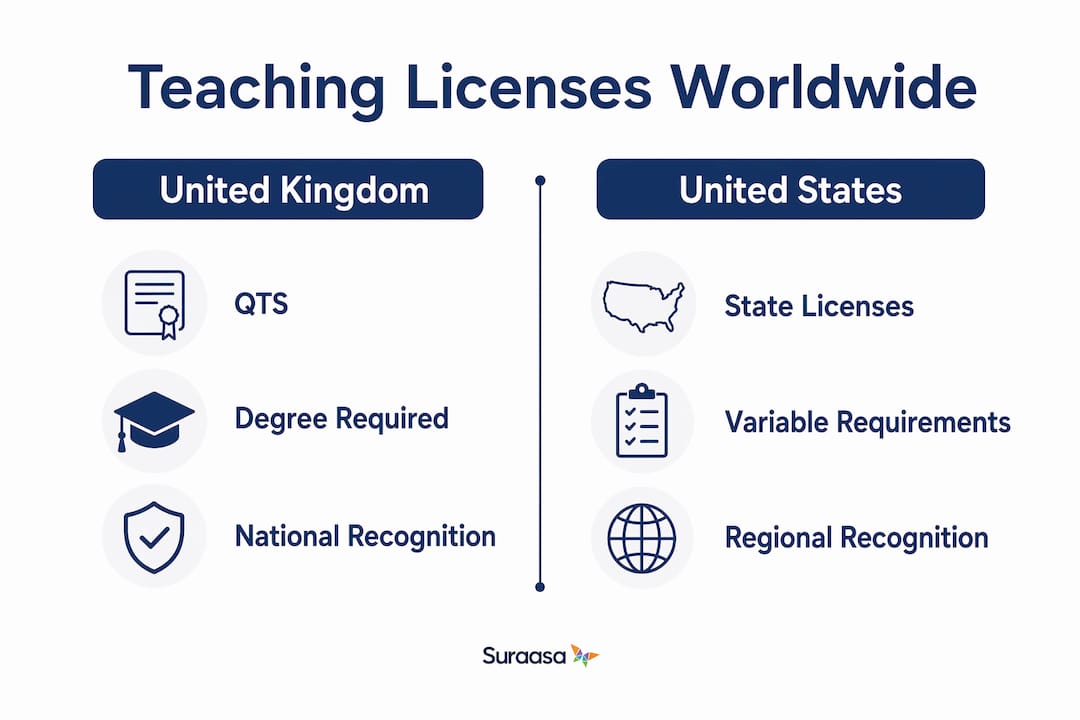
Teaching credentials vary significantly by country, and no single global license exists. Here is how the major systems compare:
| Country/Region | License Type | Key Requirement | Recognition Scope |
|---|---|---|---|
| England | Qualified Teacher Status (QTS) | UK-equivalent degree and full professional status in home country | Recognized across England; accepted by many international schools |
| United States | State-specific license | NACES credential evaluation; subject-specific coursework review | No federal license; each state licenses independently |
| Australia (NSW) | NESA Accreditation | 4 years full-time equivalent study; Working with Children Clearance | State-level; requires English proficiency proof for overseas teachers |
| India | B.Ed (often paired with CTET or a state TET) | Recognized teacher education degree; eligibility test for many school roles | National/state; commonly used as the home-country credential when applying abroad |
| International (ESL) | TEFL/TESOL Certificate | Varies by provider; 120-hour minimum common | Widely accepted for ESL roles; not equivalent to a full state license |
The distinction between a TEFL certificate and a full state or national license matters enormously. TEFL is accepted for English language teaching roles but does not qualify you for subject-specific positions at accredited international schools. Teachers who hold only a TEFL certificate often find themselves limited to language centers rather than full-curriculum schools.
England’s QTS system requires overseas-trained teachers to hold a degree equivalent to a UK undergraduate level and demonstrate full professional status in their country of origin. Australia’s NSW accreditation requires applicants to show four years of full-time equivalent study along with documents like international police checks and a Working with Children Clearance. These are not minor administrative steps. They are substantive eligibility filters.
In the United States, there is no federal teaching license. Each state issues its own credential, which means a teacher licensed in Texas must go through a separate process to teach in New York. For international teachers, this decentralization adds a layer of complexity because you must target a specific state’s requirements from the start.
Think in credential stacks, not single licenses
Here is the reframe we use with teachers planning a move: international schools rarely evaluate your license in isolation. They evaluate a credential stack, and the license is only the base layer.
- Base license: your home-country credential (for example, a B.Ed with TET, a U.S. state license, or QTS).
- Portability layer: the evaluation, apostilles, and registrations that let a foreign authority verify that base.
- Curriculum fit: evidence you can teach the framework the school uses, such as IB, Cambridge, or the British or American curriculum.
- Current practice: recent professional development that shows your teaching has moved beyond what you were assessed on years ago.
- Language evidence: IELTS, TOEFL, or proof of English-medium instruction where required.
Teachers who strengthen the weakest layer, rather than chasing a second base license they may not need, usually see faster results.
How does a teaching license affect your international job prospects?
A recognized teaching license directly expands the range of schools and countries available to you. The practical advantages are concrete:
- Salary access. In China, licensed teachers at international schools report monthly salaries between $1,700 and $4,300 USD. Figures vary widely by city, school tier, and benefits package, so treat this as indicative, but unlicensed teachers rarely access the upper pay bands.
- Visa sponsorship. Schools that sponsor work visas usually require a full teaching license. A provisional or expired credential can disqualify you before the interview stage.
- Leadership eligibility. Department head and curriculum coordinator roles at international schools typically require a licensed candidate. Without licensure, your career ceiling is lower.
- Interview advantage. Hiring managers at international schools treat a license as proof of verified competency. It reduces their risk and shortens their vetting process.
- Credential portability. A U.S. teaching license can also serve as a stepping stone for returning to teach in U.S. states through reciprocity agreements, giving you long-term career flexibility.
Beyond the job market, employers use your license to assess classroom management skills and subject knowledge. Accredited training with observed mentoring remains a non-negotiable signal for international hiring managers, and your license is the document that confirms you completed that training.
What hiring managers actually check on your license
Having the license is step one. How it reads on paper is step two. When a recruiter at an international school looks at your credential, they are typically asking five quick questions:
- Is it current? An expiry date inside your first contract year raises a flag.
- Can it be verified? A named issuing authority with an online register or verification route is easier to trust.
- Does it match the role? A license for primary grades won’t carry a secondary physics application.
- What has happened since? A gap between your license date and your recent professional learning invites questions.
- Will it survive the visa file? If documents need apostilles or translation, recruiters want to know they are already in hand.
Pro Tip: When applying to international schools, include your license number, issuing authority, subject and age-range endorsements, and expiration date directly in your CV header. Hiring managers at international schools screen dozens of applications and this detail saves them a step, which works in your favor.
How to get your teaching license recognized internationally
Getting your teaching credentials recognized abroad follows a clear sequence. Skipping steps or using the wrong document type is the most common reason applications stall.
-
Identify your target country’s licensing authority. Each country has a specific body: the Teaching Regulation Agency (TRA) for England’s QTS, NESA for NSW Australia, and individual state boards in the U.S. Start with the official government website, not forums or peer advice.
-
Order a credential evaluation from a recognized agency. In the U.S., state boards generally require a course-by-course evaluation from a NACES member agency like IEE. Turnaround and fees vary by agency and service level, from expedited options of a few business days to standard processing that takes longer, with fees commonly in the low hundreds of U.S. dollars. Check current pricing with the agency before ordering. The evaluation translates your foreign degree into a U.S. equivalent and assesses subject-specific coursework.
-
Gather your documentation set. Required documents typically include apostilled diplomas, official transcripts, language proficiency test scores, background checks, and police clearances. In the U.S. system, apostilled diplomas and NACES-approved evaluations are the usual baseline.
-
Check for country-specific add-ons. England’s QTS route may carry induction expectations depending on your route and experience, so confirm the current position with the TRA. NSW requires a Working with Children Clearance. Some Asian and Gulf markets require notarized, translated, or legalized copies of your credentials. These extras are not optional.
-
Contact the target school’s HR department directly. Schools often have faster internal processes for credential verification than national licensing bodies. HR staff can also tell you whether a provisional license is acceptable for initial employment while your full application is processed.
-
Track visa timelines in parallel. Visa timelines and sponsorship are the most common employment bottleneck for international teachers. Some schools accept provisional licenses for work authorization; others require full issuance before they submit a visa application on your behalf. Know which category your target school falls into before you accept an offer.
Pro Tip: Never rely on peer forums or Facebook groups for licensing requirements. Policies change frequently, and outdated advice has derailed more than a few international placements. Always verify requirements directly with the licensing authority or the school’s HR team.
How do teaching license requirements vary by region?
Regional differences in licensing are not just administrative. They reflect fundamentally different philosophies about teacher qualification standards.
England vs. the United States
England operates a centralized system through QTS, which gives it clear national standards. Since February 2023, the TRA has accepted QTS applications from qualified teachers trained in any country rather than a limited list, which opened the route to many teachers in South Asia, Africa, and elsewhere who meet the degree, training, and professional-status requirements. The U.S. system is decentralized across 50 state boards, which creates both flexibility and complexity. A teacher with a California license who wants to teach in New York must apply for reciprocity, and international teachers entering any U.S. state face a similar state-by-state process. The upside of the U.S. system is that credential evaluation agencies like IEE have standardized the foreign degree assessment process, making it relatively predictable once you know your target state.
Australia’s state-level accreditation
Australia’s NSW accreditation process is among the most document-intensive anywhere. Overseas-qualified teachers must provide authenticated transcripts, English proficiency records, and evidence of four years of full-time equivalent study. The Working with Children Clearance is a mandatory child safety check with no waiver. Teachers whose qualifications were not completed in English typically face an additional English proficiency requirement, usually satisfied by approved tests such as IELTS.
Middle East and Asia
International schools in the UAE, Saudi Arabia, China, and South Korea generally require a recognized license from the teacher’s home country as a baseline. Many of these schools follow U.S. or British curricula, so a U.S. state license or England’s QTS carries direct weight. Some Gulf systems, including the UAE, also layer their own national teacher licensing requirements on top of your home credential, so check what your target authority expects before you sign. In China specifically, licensed teachers access a broader range of international school positions and higher salary bands. The interplay between your teaching credential and your work visa is tighter in these markets than in most Western countries. Credential recognition must be paired with immigration legalities, and some countries accept provisional licenses for work authorization while others do not.
For jurisdiction-specific guidance, Suraasa’s resources on credential evaluation processes cover recognized evaluation bodies and country-specific requirements for internationally trained teachers.
Key takeaways
A recognized teaching license is the single most important document for accessing international teaching positions, determining salary bands, and securing visa sponsorship abroad. But it performs best as part of a complete, verifiable credential stack.
| Point | Details |
|---|---|
| License types vary by country | QTS, U.S. state licenses, Australian NESA accreditation, and India’s B.Ed/TET each have distinct requirements and recognition scopes. |
| Credential evaluation is mandatory for the U.S. | NACES member agencies like IEE translate foreign degrees into U.S. equivalents; turnaround and fees depend on the agency and service level. |
| Think in credential stacks | Schools weigh your base license alongside portability documents, curriculum fit, recent professional development, and language evidence. |
| Visa and license timelines must align | Some countries accept provisional licenses for work authorization; others require full issuance before visa processing begins. |
| Licensed teachers earn more abroad | In China, licensed teachers at international schools report monthly salaries between $1,700 and $4,300 USD, varying by city and school tier. |
| Official sources are the only reliable guide | Licensing policies change frequently; always verify requirements with the licensing authority or school HR directly. |
Why sequencing matters more than most teachers realize
Most teachers I’ve spoken with treat the license as the finish line. Get the credential, apply for jobs, move abroad. That’s the wrong frame. The license is the starting pistol, not the trophy.
The teachers who actually land international roles in competitive markets like Singapore, the UAE, and top-tier international schools in China are the ones who sequence their steps correctly. They identify their target country first, then work backward to understand exactly which credential that country’s schools and visa authorities will accept. They start the credential evaluation process months before they apply, not after they receive an offer.
A simple way to reverse-plan it: pick your target start date, count back to the main hiring season for that region, then count back again to leave room for evaluations, apostilles, and police clearances. If that last date has already passed, you are aiming at the wrong cycle, and it is better to know that now.
I’ve also seen teachers with strong licenses struggle because they ignored professional development beyond the credential itself. A license tells a school you met a minimum standard at a point in time. What gets you the leadership roles and the higher salary bands is what you’ve done since then. Continuous development through programs like Suraasa’s PgCTL, which is UK-accredited and recognized across 50+ countries, is what separates candidates who get interviews from those who get offers.
The other thing worth saying plainly: patience with the credential evaluation process is not optional. Apostille requests, police clearances, and foreign document authentication can each take weeks. Teachers who underestimate this timeline end up turning down offers or missing hiring cycles. Build in three to six months of lead time before your target start date, and you’ll avoid the most common and most avoidable mistake in international teaching career planning.
— Ankit
Start your international teaching career with the right credentials
If you’re ready to teach abroad, your credential is the foundation everything else is built on. Suraasa helps teachers get there faster.
Suraasa’s PgCTL program is a UK-accredited postgraduate qualification recognized across 50+ countries, designed specifically for teachers targeting international roles. It strengthens the “current practice” layer of your credential stack, the layer hiring managers most often find missing. Beyond the qualification itself, Suraasa provides career mentoring, job placement support, and guidance on credential recognition processes. Whether you’re working toward QTS eligibility, a U.S. state license, or international school placement in Asia or the Middle East, Suraasa connects your qualifications to real opportunities. Explore how Suraasa’s certification programs can support your path to teaching internationally.
FAQ
What is a teaching license and why does it matter abroad?
A teaching license is an official credential that authorizes you to teach in a specific region and verifies your professional qualifications. Internationally, it determines your eligibility for jobs, supports visa sponsorship, and unlocks higher salary bands at international schools.
Does the U.S. have a single national teaching license?
No. The U.S. does not have a federal teaching license. Each state issues its own credential independently, and international teachers must target a specific state’s requirements and obtain a credential evaluation from a NACES member agency.
How long does it take to get a teaching credential evaluated for the U.S.?
It depends on the agency and service level you choose. NACES member agencies like IEE offer expedited options that can take a few business days as well as standard processing, with fees commonly in the low hundreds of U.S. dollars. The evaluation translates your foreign degree into a U.S. equivalent and reviews subject-specific coursework for state board review. Gathering transcripts and apostilles beforehand often takes longer than the evaluation itself.
Can a TEFL certificate replace a full teaching license internationally?
No. A TEFL certificate qualifies you for English language teaching roles but does not substitute for a full state or national teaching license at accredited international schools offering subject-specific curricula.
What documents do most countries require for teaching license recognition?
Most countries require apostilled diplomas, official transcripts, background checks, police clearances, and proof of professional status in your home country. Some, like Australia’s NSW, also require English proficiency test scores and a Working with Children Clearance.


 Confidential & Free of Cost
