

What Is a Professional Teaching License? Your 2026 Guide

A professional teaching license is the state-issued credential that legally authorizes an educator to teach in public K-12 schools after meeting advanced educational, experiential, and examination requirements. It is the highest tier of standard teacher licensure in the United States, distinct from the provisional or initial certificates issued to new teachers. Licensure grants legal permission to practice, while voluntary certifications may add advanced credentials on top of that. If you’re figuring out how to get a teaching license or looking to upgrade your current one, this guide covers every step.
What is a professional teaching license and who needs one?
A professional teaching license is the credential required to teach full-time in any U.S. public school district. All 50 states require at least a bachelor’s degree for standard teacher certification as of 2026. That baseline requirement tells you something important: this is not an entry-level credential. It signals that you have completed a structured preparation program, passed state-approved exams, and demonstrated readiness in an actual classroom.
The license is issued by each state’s department of education, not by a school or university. This means your license belongs to you, not your employer. Private schools typically operate under different rules and may not require state licensure, but any public school district in the country will ask for it before you can legally stand in front of a class.

Understanding the difference between licensure and certification matters here. Licensure is the mandatory government authorization. Professional teaching certification, by contrast, can sometimes be a voluntary advanced credential, such as National Board Certification through the National Board for Professional Teaching Standards. Both are worth pursuing, but licensure comes first.
What are the typical eligibility requirements for a professional teaching license?
The core requirements are consistent across states, though the specific exams and program names differ. Here is what you will need to meet before applying:
-
Bachelor’s degree from a regionally accredited institution, typically in education or in the subject area you plan to teach
-
Approved teacher preparation program, either a traditional university-based program or a state-approved alternative route such as Teach For America or a district-run residency
-
Standardized exams, including content knowledge tests like the Praxis Subject Assessments and pedagogy tests like the Praxis Principles of Learning and Teaching
-
Supervised student teaching or field experience, usually a full semester of classroom practice under a licensed cooperating teacher
-
Background check and character review, required in every state to confirm fitness for working with minors
The exam requirements vary more than people expect. California uses the CSET and CalTPA. New York requires the edTPA portfolio alongside the NYSTCE exams. Texas uses the TExES series. If you are planning to teach in a specific state, confirm the exact exam requirements with that state’s board of education before enrolling in a preparation program.
Pro Tip: Start your background check early. Processing times can run four to eight weeks in some states, and a delayed clearance can push back your application timeline by an entire semester.
How does the tiered licensure system work?
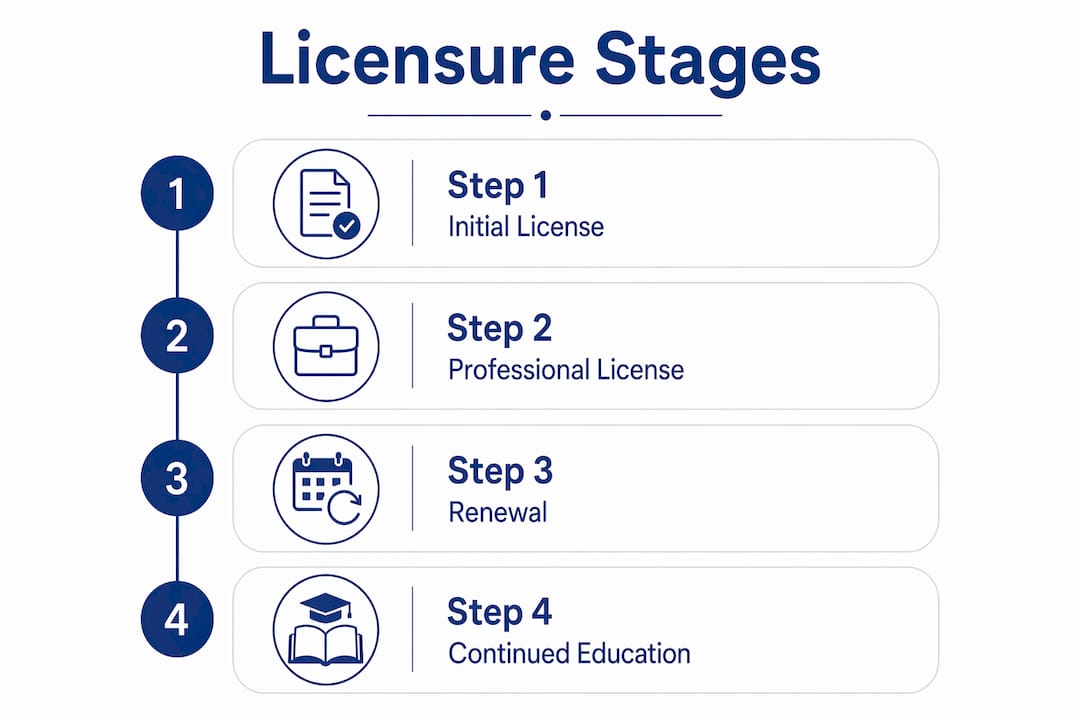
Most states use a two or three-tier system that moves educators from an initial license to a professional one. Understanding this progression is one of the most practical things you can do before you start the process.
| Feature | Initial/Provisional License | Professional License |
|---|---|---|
| Purpose | Allows teaching while completing remaining requirements | Full authorization after meeting all advanced criteria |
| Validity period | Typically 3 to 5 years | Renewal every 5 to 10 years |
| Degree requirement | Bachelor’s degree | Often requires master’s degree or equivalent credits |
| Teaching experience | Not yet required | Usually 3 or more years of verified classroom experience |
| Professional development | Minimal or none required | Continuing education hours required for renewal |
| Renewal difficulty | Straightforward upgrade | Requires documented proof of ongoing learning |
Initial certificates are valid for 3 to 5 years and must be upgraded to professional certificates by completing additional teaching experience, often a master’s degree, and professional development hours. That window sounds generous, but it passes faster than most new teachers expect.
The transition from initial to professional is where many educators run into trouble. Failing to apply on time for the upgrade from an initial to a professional license can result in a certification lapse, which requires reissuance under more difficult conditions. A lapsed license can restrict your ability to work and may require you to resubmit documentation you already provided years earlier.
The professional license, once earned, typically carries a renewal cycle of five to ten years depending on the state. New York, for example, operates on a five-year cycle. California’s clear credential does not expire but requires periodic renewal through professional development. Knowing your state’s specific cycle is not optional. It is the kind of detail that protects your career.
What are the ongoing maintenance requirements for a professional license?
Earning your professional license is not the end of the process. Maintaining it requires consistent effort, organized record-keeping, and awareness of your state’s renewal deadlines.
-
Complete CTLE hours. Professional teaching licenses require ongoing Continuing Teacher and Leader Education (CTLE) hours to remain valid. Most states mandate a set number of hours per renewal cycle, often between 100 and 175 hours over five years.
-
Document everything. You must track and submit proof of your professional development credits when you apply for renewal. Workshops, graduate coursework, instructional coaching, and approved online courses all typically count.
-
Organize records digitally from day one. Organizing evidence digitally from the start is best practice. A simple folder system with certificates, transcripts, and attendance records saves significant time when renewal deadlines approach.
-
Submit your renewal application before the deadline. Most state boards of education allow you to apply for renewal 90 to 180 days before your license expires. Missing this window can trigger a lapse.
-
Pay the renewal fee. Renewal fees range from $50 to $200 depending on the state. Budget for this as a routine professional expense.
The consequences of failing to maintain your license go beyond paperwork. A lapsed license means you cannot legally teach in a public school until the issue is resolved. Some districts will place you on unpaid leave during the gap. Others will terminate the contract entirely.
Pro Tip: Set a calendar reminder 12 months before your license expiration date. Use that year to complete any remaining CTLE hours and gather your documentation so the renewal application is ready to submit the moment the window opens.
How do state variations and reciprocity affect your license?
Each state issues its own teaching licenses with its own criteria, and teacher licenses are not automatically transferable between states. Reciprocity agreements exist, but they are not universal and rarely cover every license type or subject area.
Here is what you should expect if you are relocating or considering a move:
-
Research the destination state’s requirements before you move. Some states accept out-of-state licenses with minimal additional requirements. Others require you to pass state-specific exams or complete additional coursework before they will issue a new license.
-
Check for reciprocity agreements. The National Association of State Directors of Teacher Education and Certification (NASDTEC) maintains interstate agreements that many states use as a framework, but participation and scope vary significantly.
-
Expect subject-area differences. A secondary math license from Ohio may not map directly to a secondary math license in Florida if the content standards or grade-band definitions differ.
-
Plan for processing time. Even in states with strong reciprocity, the application review process can take 60 to 120 days. If you are starting a new job, apply for the new state license before you move.
-
Some states require additional testing. California, for instance, requires the RICA reading instruction exam for elementary teachers regardless of prior licensure elsewhere.
Educators who assume their existing professional license will transfer without any additional steps often face delays that affect their employment start dates. Planning ahead is the only reliable way to avoid that outcome.
Key takeaways
A professional teaching license is a state-issued credential requiring a bachelor’s degree, approved preparation, passing exams, supervised experience, and ongoing professional development to earn and maintain.
| Point | Details |
|---|---|
| Definition of the license | A state-issued legal authorization to teach in public K-12 schools after meeting advanced requirements. |
| Core eligibility requirements | Bachelor’s degree, approved preparation program, standardized exams, student teaching, and background check. |
| Tiered system progression | Initial licenses last 3 to 5 years; professional licenses require experience, often a master’s degree, and continuing education. |
| Ongoing maintenance | CTLE hours must be documented and submitted every renewal cycle, typically every 5 to 10 years. |
| State portability | Reciprocity is not automatic; research destination state requirements before relocating to avoid employment delays. |
Why the transition from initial to professional is where most teachers stumble
I have worked with hundreds of educators navigating the certification process, and the pattern is consistent. Teachers who struggle are almost never the ones who fail their Praxis exams on the first attempt. They are the ones who earn their initial license, start teaching, and then treat the professional upgrade as something they will handle later.
Later arrives faster than expected. A five-year initial license window feels long when you are in your first classroom. By year three, you are managing a full course load, possibly a graduate program, and a personal life. The upgrade application gets pushed to the back of the list. Then year five arrives and the paperwork is not ready.
The shift toward performance-based assessments like edTPA is also changing what the professional license process looks like. States are moving away from pure test scores and toward portfolios that document actual teaching practice. This is a better measure of readiness, but it requires more planning. You can’t cram for a teaching portfolio the week before your deadline.
My honest advice: treat your professional license upgrade the same way you treat your health insurance renewal. Put it on the calendar. Set reminders. Keep your documentation current. The educators who do this never have a crisis. The ones who don’t often wish they had.
— Ankit
How Suraasa helps you build a teaching career that travels
Getting your professional teaching license is one step. Building a career that grows with you, whether in the U.S. or internationally, is another challenge entirely.

Suraasa is an online platform built specifically for teachers who want more from their careers. From UK-accredited qualifications through the PgCTL program to career mentoring, job placement support, and professional development resources, Suraasa gives you the tools to move forward. The platform operates across 50+ countries and is backed by Reach Capital and ETS, two of the most respected names in education. If you are ready to take your teaching credentials further, explore what Suraasa offers and see how it fits your goals.
FAQ
What does a professional teaching license allow you to do?
A professional teaching license legally authorizes you to teach full-time in public K-12 schools in the state that issued it. Without it, you cannot hold a permanent teaching position in any U.S. public school district.
How long does it take to get a professional teaching license?
The timeline depends on your starting point. Completing a bachelor’s degree and teacher preparation program typically takes four years, followed by a transition period of three to five years on an initial license before you qualify for the professional credential.
Is a professional teaching license the same in every state?
No. Each state sets its own requirements, exams, and renewal cycles. Reciprocity agreements exist between some states, but they are not automatic and may require additional testing or coursework when you move.
What happens if your teaching license expires?
A lapsed license means you cannot legally teach in a public school until it is reinstated. Reinstatement often requires resubmitting documentation and may involve additional requirements beyond a standard renewal.
Do private schools require a professional teaching license?
Most private schools are not required by law to hire state-licensed teachers, though many prefer or require it. Requirements vary by state and by individual school policy.
Article generated by


 Confidential & Free of Cost
