

What Is Online Teacher Training? Your 2026 Guide

Online teacher training is defined as a collection of digital programs that equip educators with the pedagogical skills, technological proficiency, and inclusive teaching practices needed to perform effectively in modern classrooms. These programs range from short professional development modules to full degree-based certification pathways. 96% of teachers in MOOC-based studies reported changed classroom practice after completing online training. That figure tells you these programs produce real results, not just credentials. Whether you’re a career changer, a paraprofessional seeking full licensure, or an experienced educator looking to grow, online teacher training gives you a structured path forward without requiring you to leave your job or relocate.
What is online teacher training, and how does it work?
Online teacher training, also called online teacher professional learning or virtual teacher training, refers to structured digital programs delivered through learning management systems, video platforms, and live virtual classrooms. The industry standard term is “online teacher professional development,” though “online teacher training” is the phrase most educators search for. Programs are offered by universities, government bodies, and specialized platforms like Suraasa, and they cover everything from classroom management to subject-specific pedagogy.
The core mechanism is straightforward. You access course content through a web browser, complete assignments on your own schedule or during scheduled live sessions, and receive feedback from instructors or peers. Some programs include virtual simulations of classroom scenarios. Others require you to apply skills directly in your current teaching role and submit evidence of practice.

Suraasa, for example, operates across 50+ countries and offers qualifications regulated by OFQUAL, the UK government body that oversees educational standards. Its flagship PgCTL program carries an ATHE Level 6 credential and combines online coursework with career mentoring and job placement support. That combination of a recognized, regulated qualification plus career services is increasingly common among quality providers, and it is worth understanding precisely what “accredited” means before you enroll anywhere.
What formats and types of programs are available?
Online teacher training programs come in several distinct formats. Understanding the differences helps you pick the right fit for your schedule, career goals, and budget.
Short professional development modules are typically 4–20 hours long. They focus on a single skill, such as differentiated instruction or digital assessment tools. These are ideal if you need continuing education credits or want to address a specific gap in your practice.
Graduate certificate programs run 6–12 months and cover broader competencies. They often satisfy requirements for salary advancement or specialized endorsements. Suraasa’s PgCTL, an OFQUAL-regulated ATHE Level 6 qualification, sits in this category.
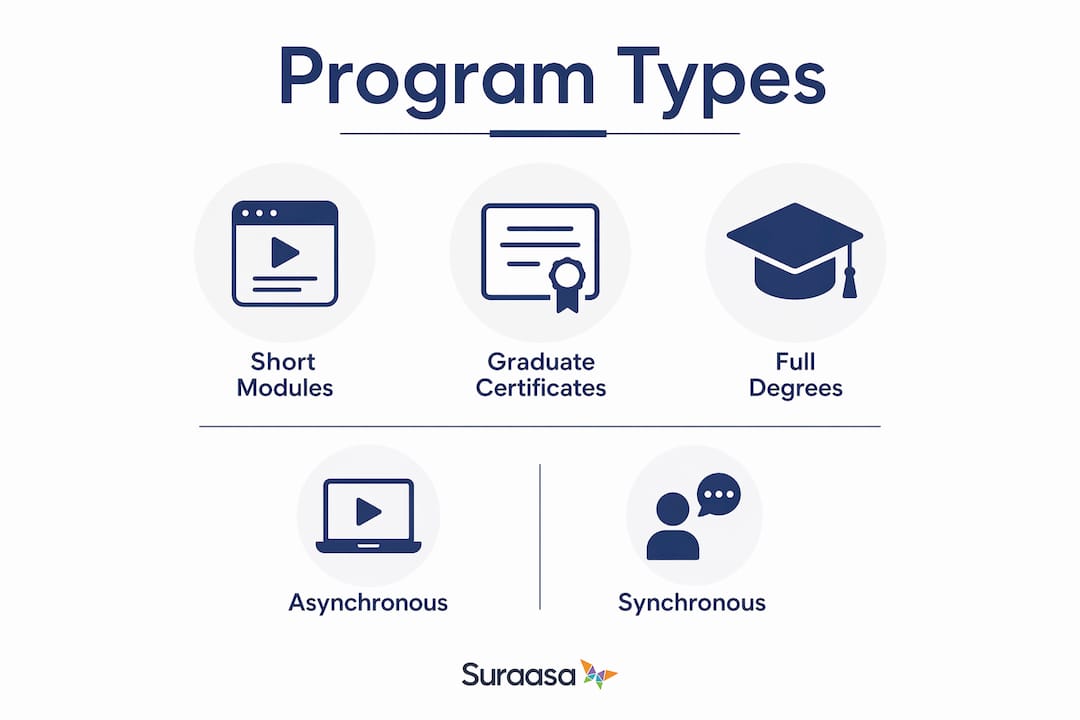
Full degree programs, such as a Master of Arts in Teaching (MAT), take 1–2 years and lead to full licensure in most states. Kentucky Christian University’s MAT program is a strong example. It offers a fully online, job-embedded pathway called Option 6, which allows candidates to teach full-time while completing coursework and supervised clinical experience simultaneously.
MOOCs (Massive Open Online Courses), offered through platforms connected to institutions like Harvard University, provide open access to teacher education content. They work well for building knowledge but often suffer from low completion rates when instructor presence is weak.
Here is a quick breakdown of common program types:
- Short PD modules: 4–20 hours, single skill focus, low cost, no degree credit
- Graduate certificates: 6–12 months, multi-competency, may count toward a degree
- MAT or MEd degree programs: 1–2 years, leads to full licensure, highest career impact
- MOOCs: Self-paced, open access, variable quality, best used as supplements
- Job-embedded pathways: Work while you learn, clinical hours completed in your current classroom
Asynchronous programs let you work at your own pace, which suits educators with unpredictable schedules. Synchronous programs include weekly live sessions and tend to produce better engagement and completion rates.
What are the key benefits compared to traditional programs?
The benefits of online teacher training over traditional, on-campus programs are concrete and measurable. Cost is the most immediate advantage. Online programs remove commuting and housing costs entirely, and tuition is often lower than comparable on-campus options. For working teachers, that financial relief is significant.
Flexibility is the second major benefit. You can complete coursework in the evenings or on weekends without taking leave from your current position. This matters especially for educators in rural or underserved areas where the nearest university may be hours away. Online training removes geographic barriers that have historically kept qualified candidates out of advanced programs.
| Factor | Online teacher training | Traditional on-campus |
|---|---|---|
| Cost | Lower, no housing or commute | Higher, includes campus fees |
| Flexibility | Evenings, weekends, self-paced | Fixed class schedule |
| Geographic access | Available anywhere with internet | Limited to local institutions |
| Peer diversity | Global cohorts | Mostly local cohorts |
| Clinical experience | Varies, often job-embedded | Typically required on-site |
| Engagement risk | Lower without active facilitation | Higher with in-person interaction |
The table above shows one important tradeoff. Online programs carry a real engagement risk. Active facilitation is crucial for keeping learners on track. Passive, self-paced modules without instructor feedback show lower completion rates than programs with structured interaction built in.
Pro Tip: Before enrolling, ask the program directly how often instructors provide feedback and whether live sessions are part of the curriculum. That single question separates high-quality programs from low-engagement ones.
Online programs also expose you to a more diverse peer group. When your cohort includes teachers from different countries and school systems, the discussions about classroom practice become far richer than anything a single campus can offer.
How do certification and licensure work in online programs?
Certification and licensure are not the same thing, and confusing them is one of the most common mistakes prospective teachers make. A certificate is an educational credential issued by a university or training provider. Licensure is state authorization to teach in a public school. You need both to work as a fully licensed teacher in most U.S. states.
Certificates differ from licensure in a critical way. A certificate proves you completed a program. A license proves your state has verified your qualifications and approved you to teach. Many online programs lead to certificates but not automatically to licensure. You must verify that your chosen program aligns with your state board’s requirements before you enroll.
It also helps to know what genuine accreditation looks like. A vague “UK-accredited” label tells you little on its own. What matters is the specific regulator and level. Suraasa’s PgCTL, for instance, is regulated by OFQUAL and sits at ATHE Level 6, which is equivalent to the final year of a UK bachelor’s degree. Naming the regulator and the level is exactly the kind of specificity you should demand from any provider.
Here is what to check before committing to any program:
- Accreditation status: Confirm the program is accredited by a recognized body such as CAEP (Council for the Accreditation of Educator Preparation) in the U.S., or regulated by a named authority such as OFQUAL in the UK, with the qualification level clearly stated.
- State alignment: Ask whether the program satisfies your state’s licensure requirements, including any required coursework in special education or student teaching hours.
- Clinical experience requirements: Most states require supervised student teaching. Verify whether your current classroom role qualifies as clinical experience or whether you need separate placement.
- Provisional to full licensure pathways: If you are already provisionally certified, look for programs like Kentucky Christian University’s Option 6, which are designed specifically for working adults seeking full licensure.
For career changers, the path is slightly different. You will likely need a program that includes both content knowledge coursework and supervised teaching hours. Some states offer alternative certification routes that can be completed entirely online, but they still require a final licensure exam such as the Praxis series.
Well-structured online programs in STEM and literacy show improved teaching knowledge and sometimes improved student outcomes. However, quality varies widely across providers. Recognized, regulated accreditation is the clearest signal of program credibility and career impact.
How do you choose the right program and succeed in it?
Choosing the right online teacher training program comes down to four factors: format, accreditation, cost, and support services. Get those four right and the rest follows.
Start with format. If your schedule is unpredictable, an asynchronous program gives you the control you need. If you know you struggle with self-motivation, a program with weekly live sessions and structured deadlines will serve you better. Blending asynchronous content with live sessions significantly improves completion rates. That is not a preference. It is a documented pattern across online professional learning research.
Next, check accreditation and state alignment as described in the previous section. Insist on specifics: which body accredits or regulates the program, and at what level. A qualification regulated by OFQUAL at ATHE Level 6, like Suraasa’s PgCTL, carries far more weight than a program that only markets itself as “UK-accredited.” Then compare costs carefully. Factor in not just tuition but also technology fees, exam fees, and the cost of any required materials.
Finally, evaluate support services. The best programs offer academic advisors, peer learning communities, tutoring, and job placement assistance. Suraasa, for instance, pairs its training programs with career mentoring and direct placement support across its global network.
Here are practical tips for succeeding once you are enrolled:
- Block study time on your calendar the same way you would block a class. Treat it as a non-negotiable appointment.
- Attend every live session available. Teachers prefer online PD that combines flexibility with structured interaction. Live sessions are where the real learning happens.
- Connect with peers early. Introduce yourself in discussion forums in the first week. Cohort relationships improve both engagement and completion.
- Use your advisor. Most programs assign an academic advisor. Contact them before problems arise, not after.
- Apply learning immediately. Try new strategies in your classroom the week you learn them. Reflection on real application deepens retention far more than re-reading notes.
Pro Tip: If your program requires clinical hours, confirm in writing before enrolling whether your current teaching position satisfies that requirement. Discovering a gap after enrollment costs you both time and money.
Key takeaways
Online teacher training delivers measurable career outcomes when you choose an accredited, well-facilitated program that aligns with your state’s licensure requirements and your own schedule.
| Point | Details |
|---|---|
| Definition is specific | Online teacher training covers digital programs from short PD modules to full MAT degrees. |
| Accreditation is non-negotiable | Only programs from named, recognized regulators (such as CAEP or OFQUAL) with a clear qualification level lead to valid credentials and career advancement. |
| Engagement requires structure | Programs with live sessions and instructor feedback produce higher completion than passive self-paced courses. |
| Cost advantage is real | Removing commuting and housing costs makes online programs significantly more affordable than on-campus options. |
| Clinical hours need verification | Confirm whether your current teaching role qualifies as supervised clinical experience before enrolling. |
My take on where online teacher training actually falls short
I’ve spent years watching educators enroll in online programs with genuine enthusiasm, only to disengage by week six. The problem is almost never the content. It’s the design. Too many programs treat flexibility as a substitute for structure. They give you 12 weeks of video lectures and a discussion board and call it professional development. That is not training. That is a library with a deadline.
The programs that actually change how teachers teach are the ones that require you to do something in your classroom, reflect on it, and bring that reflection back to a live session with peers and an instructor who pushes back. Kentucky Christian University’s job-embedded model gets this right. Suraasa’s approach of combining a regulated qualification with mentoring and placement support gets this right. Most MOOCs do not.
I also think the certification versus licensure confusion causes real harm, and so does vague accreditation language. Educators spend money on certificates that do not move them closer to full licensure because they did not ask the right questions upfront. When a provider only says “UK-accredited,” push for the detail: is it regulated by OFQUAL, and at what level? Suraasa’s PgCTL being an OFQUAL-regulated ATHE Level 6 qualification is a concrete claim you can verify. “UK-accredited” on its own is not. The fix is simple: call your state’s department of education, or check the regulator directly, before you enroll anywhere and ask exactly which programs they recognize. That one call saves you from a costly mistake.
The future of online teacher training is genuinely promising, particularly for educators in underserved regions who have never had access to quality professional development. But access alone is not enough. The field needs more programs that combine the flexibility of online delivery with the rigor of structured, facilitated learning. When those two things come together, the results speak for themselves. 96% of teachers reporting changed classroom practice is not a small number.
— Ankit
Start your online teacher training with Suraasa
If you’re looking for an accredited online teacher training program that leads to real career outcomes, Suraasa is built for exactly that. The platform serves educators across 50+ countries with qualifications regulated by OFQUAL, the UK government body responsible for educational standards, alongside career mentoring and direct job placement support.

Suraasa’s flagship PgCTL program is an OFQUAL-regulated ATHE Level 6 qualification that prepares teachers for international teaching roles through a structured online curriculum backed by investors including Reach Capital and ETS. Whether you want to teach abroad, move into a higher-paying role, or simply build stronger credentials, Suraasa connects your training to your next career step. Explore your program options at Suraasa and speak with an advisor to find the pathway that fits your schedule and goals.
FAQ
What is the difference between online teacher training and certification?
Online teacher training refers to the programs and courses you complete to develop teaching skills. Certification is the credential you receive after completing a program, while licensure is the separate state authorization required to teach in public schools.
How long does online teacher training take?
Program length varies by type. Short professional development modules take 4–20 hours, graduate certificates take 6–12 months, and full MAT degree programs typically take 1–2 years to complete.
Does online teacher training lead to a teaching license?
Not automatically. A program must be accredited and aligned with your state board’s requirements for it to count toward licensure. Always verify state alignment before enrolling in any online teacher certification program.
What does “UK-accredited” actually mean for a teaching qualification?
On its own, “UK-accredited” is vague. Look for the specific regulator and level instead. Suraasa’s PgCTL, for example, is regulated by OFQUAL and awarded at ATHE Level 6, which is equivalent to the final year of a UK bachelor’s degree. Naming the regulator and level is how you confirm a qualification is genuinely recognized.
What is e-learning for teachers, and is it effective?
E-learning for teachers is the delivery of professional development and certification coursework through digital platforms. Research shows 96% of participants in MOOC-based teacher training reported changed classroom practice, though effectiveness depends heavily on program design and instructor presence.
Can I complete clinical teaching hours online?
Clinical hours typically require in-person classroom experience, but job-embedded programs like Kentucky Christian University’s Option 6 allow you to use your current teaching position as your supervised clinical placement, which removes the need for a separate student teaching assignment.


 Confidential & Free of Cost
