

Why Teachers Need Global Certification in 2026

Global teaching certification is a recognized benchmark of professional quality that shows a teacher meets international standards for classroom practice, pedagogy, and student outcomes. If you’re weighing whether to pursue credentials beyond your local license, the answer is clear: why teachers need global certification comes down to three things — better pay, broader career access, and stronger teaching. Credentials like UK Qualified Teacher Status (QTS), CELTA, and the American Board International Teaching Certification are no longer optional extras. In 2026, they are the baseline that international schools, accreditation bodies, and top-tier recruiters expect to see.
Why teachers need global certification
Global teaching certification is not just a hiring formality. Research published in PMC links certification to higher student achievement, largely because it increases teacher efficacy and encourages more innovative classroom practice. That means the credential you earn directly shapes what happens in your classroom, not just what appears on your resume.
The importance of teacher certification shows up most clearly in how it changes your professional identity. When you hold a globally recognized credential, you signal to employers, parents, and colleagues that you’ve met an independently verified standard. That signal carries weight across borders in ways that years of experience alone cannot replicate, because a hiring committee in Dubai or Singapore has no easy way to verify your local track record, but it can verify a credential.
Certification also gives you a structured framework for reflecting on your own teaching. Earning credentials like CELTA or UK QTS requires you to demonstrate competency in lesson planning, differentiated instruction, and student assessment, usually under observation and with formal feedback. That process builds skills that stay with you long after the certificate is issued.
Certification is more than a hiring hurdle. It’s a professional development process that changes how teachers think about their practice — a theme that runs through the PMC research on teacher certification and student achievement.
Pro Tip: If you’re early in your career, pursue a globally recognized credential before you specialize. It gives you a portable foundation that works across countries and school systems.
How does certification improve teaching quality?
The connection between certification and classroom performance is backed by data. OECD findings show that teachers with formal degrees and recognized training spend more time on active instruction and are associated with better student outcomes in PISA 2022 — still the most recent PISA cycle with published results as of 2026, with PISA 2025 results expected later this year. More active instruction time means students learn more, and that difference is measurable.

The first mechanism behind this is teacher efficacy. When teachers feel confident in their methods because those methods have been formally validated, they take more productive risks in the classroom. They try new approaches, adapt to different learners, and recover faster from lessons that don’t land. The PMC research identifies this increased efficacy as one of the primary pathways through which certification improves student success.
Pedagogical knowledge is the second driver. Certification programs require teachers to study how learning works, not just what they teach — from cognitive load and formative assessment to classroom language and behaviour management. That knowledge base separates teachers who manage classrooms from teachers who transform them.
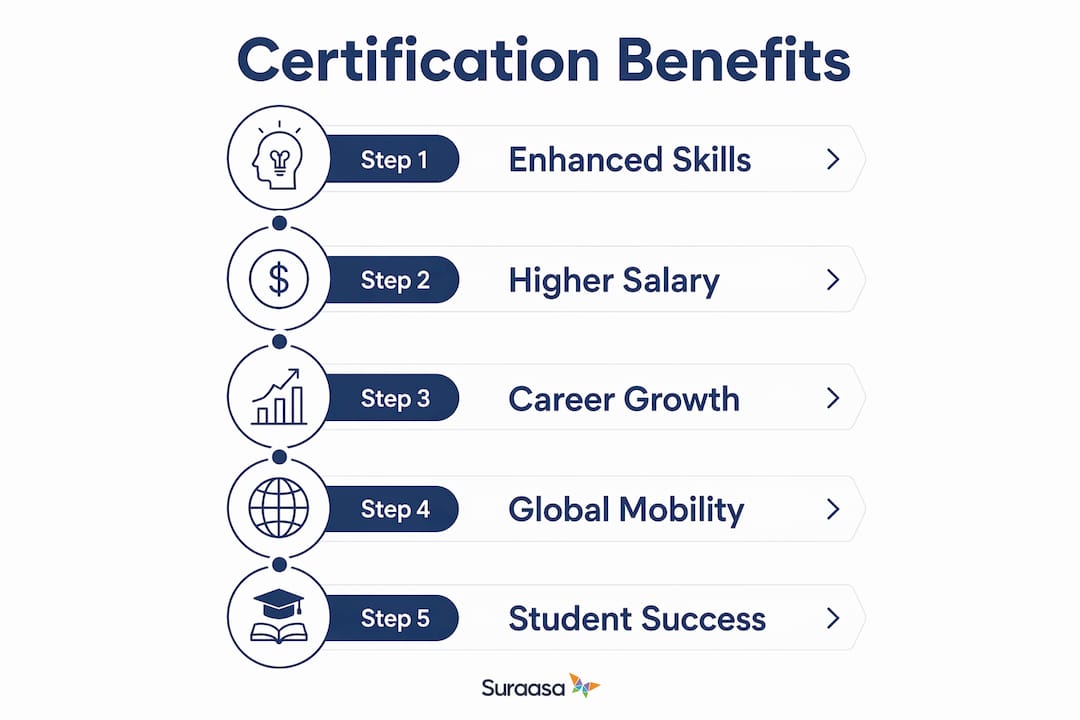
The impact of certification on teaching is also cumulative. Teachers who pursue credentials tend to stay current with research, seek out professional learning communities, and take on mentorship roles. Certification starts a cycle of professional growth that compounds over time.
What career advantages do global credentials offer?
The salary impact of global certification is direct and significant. Teachers who upgrade to gold-standard certifications — for example, moving from a basic online TEFL certificate to CELTA with a Pass-B or Pass-A grade — commonly report salary increases in the range of 20–40% in comparable roles. Without those upgrades, many entry-level teachers in language and lower-tier private schools find their pay stalling at around $1,800 per month even after a decade in the classroom. Exact figures vary by country and school, but the pattern is consistent.
That plateau is the real risk. Experienced teachers without upgraded credentials miss out on leadership roles and higher salary tiers, regardless of how many years they’ve spent in the classroom. Long teaching experience alone rarely leads to top-tier compensation or advancement.
Global credentials also function as professional currency. International credentials signal adaptability and cultural competence that recruiters at international schools actively look for. That signal goes beyond subject knowledge. It tells a hiring committee that you can work across cultures, manage diverse classrooms, and meet the expectations of globally minded families.
Here’s what certified teachers gain access to that uncertified teachers typically don’t:
- International school placements in the Middle East, Southeast Asia, Europe, and beyond
- Visa and work permit eligibility in countries that require formal teaching credentials for sponsorship
- Leadership track consideration for department head, curriculum coordinator, and principal roles
- Higher starting salaries at accredited schools that pay certified teachers on a separate pay scale
- Accreditation-linked hiring at schools that must verify teacher credentials to maintain their own accreditation status
International schools often require formally verifiable credentials like UK QTS to maintain accreditations and attract families. Teachers without formal qualifications face real hiring limitations, even with years of classroom experience.
| Career Factor | Without Global Certification | With Global Certification |
|---|---|---|
| Salary ceiling | Often plateaus around $1,800/month | Commonly 20–40% higher in comparable roles |
| International hiring | Limited by credential gaps | Eligible for accredited school roles |
| Leadership access | Experience-based, slow | Credential-supported, faster track |
| Visa sponsorship | Often ineligible | Frequently required for eligibility |
| Professional standing | Local recognition only | Recognized across multiple countries and school systems |
CELTA vs. UK QTS vs. American Board: which fits your goals?
Choosing the right credential depends on where you want to teach and what you want to teach. The three most recognized global certifications each serve different career paths, and newer routes like International QTS (iQTS) and UK-accredited online programs have widened the options for teachers who can’t relocate to train.
Pro Tip: Before you apply to any certification program, research the hiring requirements of your target country or school network. Some regions require UK QTS specifically; others accept CELTA for language teaching roles. Matching your credential to your market saves time and money.
| Certification | Best For | Recognition | Typical Cost | Time to Complete |
|---|---|---|---|---|
| CELTA (Cambridge) | English language teaching | Worldwide, especially Asia and Europe | Roughly $1,500–$2,500, varies by centre | 4 weeks (intensive) or 3–6 months (part-time) |
| UK QTS | Mainstream K-12 international schools | UK and international accredited schools | Varies by pathway | From a few months (Assessment Only) to 1–2 years, depending on route |
| American Board International | U.S. curriculum schools abroad | U.S.-aligned international schools | Around $1,000 and up; check current pricing | Self-paced, typically 3–6 months |
| Suraasa PgCTL | Career advancement and international placement | UK-accredited, recognized in 50+ countries | Program-based | Flexible, online |
Popular options include CELTA, UK QTS, and American Board International Teaching Certification, and each one targets a different segment of the global teaching market. CELTA is the go-to for English as a Second Language roles. UK QTS opens doors at accredited international schools that follow British or IB curricula. American Board works well for teachers targeting U.S.-curriculum schools in the Middle East or Latin America.
Accreditation portability matters more than most teachers realize. A credential that is recognized in one country may carry no weight in another. Fees and entry requirements also change from year to year, so before investing time and money, verify current costs with the provider and confirm that your target schools or regions accept the specific certification you’re pursuing.
How to pursue global certification step by step
Getting certified globally is a process you can plan deliberately. Follow these steps to move from where you are now to where you want to be.
-
Audit your current qualifications. List every credential you hold, including your local teaching license, subject degrees, and any professional development certificates. Identify gaps between what you have and what your target market requires.
-
Define your target region and school type. Research whether you want to teach in the Middle East, Southeast Asia, Europe, or elsewhere. Each region has different credential preferences. International schools following British curricula prioritize UK QTS; language schools prioritize CELTA.
-
Match your credential to your goal. Use the comparison table above to select the certification that fits your region, subject area, and budget. Don’t pursue a credential just because it’s well-known. Pursue the one that opens the specific doors you want to walk through.
-
Calculate your return on investment. A CELTA program costs roughly $1,500–$2,500. If it leads to a role paying 25% more than your current position, you can recover that cost within months. Factor in course fees, time off work, and any travel, then run the numbers before you commit.
-
Apply through an accredited provider. For CELTA, Cambridge-approved centres are the only valid option. For UK QTS, recognized routes include school-led and university-led initial teacher training, the Assessment Only pathway for experienced teachers, and, for qualified teachers trained outside England, the government’s application route for QTS recognition. Teachers based abroad can also look at International QTS (iQTS). For Suraasa’s PgCTL, the program is UK-accredited and delivered online, which works well for teachers who can’t relocate for training.
-
Build continuous professional development into your plan. Certification is a starting point, not a finish line. Clearer certification pathways improve both recruitment and quality, but staying competitive means adding specializations, subject endorsements, or leadership credentials over time.
The value of international teaching licenses grows when you treat them as part of a career strategy rather than a one-time achievement. Teachers who keep upgrading their credentials stay ahead of the market. Those who don’t risk the stagnation that credential gaps create over a decade or more.
Developing communication skills for international settings alongside your certification also strengthens your profile. Cultural competence and clear communication are skills that international schools look for beyond the credential itself.
Key takeaways
Global teaching certification is one of the most reliable ways to increase your salary, expand your career options, and improve your classroom practice across international markets.
| Point | Details |
|---|---|
| Certification improves teaching | Formally trained teachers spend more time on active instruction and are linked to better student outcomes. |
| Salary impact is real | Gold-standard credentials like CELTA can unlock a 20–40% salary increase over less-qualified peers. |
| International schools require credentials | Accredited schools verify formal qualifications to maintain their own accreditation status. |
| Choose credentials strategically | Match your certification to your target region and school type for the best career return. |
| Ongoing development matters | One credential is a start; continuous upgrades keep you competitive in the global market. |
What I’ve learned watching teachers go global
I’ve seen teachers with 15 years of classroom experience get passed over for international roles because they couldn’t produce a verifiable, globally recognized credential. That’s not a hiring bias. That’s a structural reality. International schools answer to accreditation bodies, and those bodies require proof.
What surprises most teachers is how quickly the credential changes their confidence. The process of earning UK QTS or completing a PgCTL program forces you to articulate your teaching philosophy, defend your methods, and demonstrate competency in ways that local licensing rarely demands. That process is uncomfortable. It’s also exactly what makes you a better teacher.
The market trend is clear. Schools in the UAE, Singapore, the UK, and across Europe are raising their credential requirements, not lowering them. Teachers who invest in global certification now are positioning themselves ahead of that curve. Those who wait are narrowing their options with every passing year.
My honest advice: don’t treat certification as a box to check. Treat it as a professional investment with a measurable return. The teachers I’ve seen thrive internationally are the ones who pursued credentials with a specific career goal in mind, then kept building from there. Developing academic communication skills alongside your credentials also gives you an edge in international classrooms where clarity and cultural adaptability matter daily.
— Ankit
How Suraasa helps you get certified and placed
Suraasa is built specifically for teachers who want to move from local practice to international careers. Its flagship program, the PgCTL, is UK-accredited and recognized in 50+ countries. It prepares you for international teaching roles through structured coursework, career mentoring, and direct job placement support.
Beyond the PgCTL, Suraasa offers supplementary courses, assessment tools, and a recruitment network that connects certified teachers with schools actively hiring. If you’re ready to turn your teaching experience into a globally recognized credential and a concrete career move, Suraasa gives you the program, the support, and the placement network to make that happen.
FAQ
What is global teaching certification?
Global teaching certification is a formally recognized credential that verifies a teacher meets international standards for pedagogy, classroom practice, and professional conduct. Examples include UK QTS, CELTA, and the American Board International Teaching Certification.
How does certification affect a teacher’s salary?
Teachers who earn gold-standard certifications like CELTA Pass-B or Pass-A commonly see a 20–40% salary increase compared to less-qualified peers in similar roles, though exact figures vary by country and school. Without credential upgrades, many teachers plateau at lower salary tiers regardless of experience.
Which global teaching certification is most recognized?
UK QTS is the most widely recognized credential for mainstream international school roles, while CELTA leads for English language teaching positions. The right choice depends on your target region and school type.
Do international schools require global certification?
In most cases, yes. Accredited international schools require formally verifiable credentials to maintain their accreditation status. Teachers without recognized qualifications face hiring limitations even when they have significant classroom experience.
How long does it take to get globally certified?
It depends on the credential. CELTA takes 4 weeks intensive or up to 6 months part-time. UK QTS pathways typically take 1–2 years, though experienced teachers on the Assessment Only route can finish faster. The American Board International Certification is self-paced and often completed in 3–6 months.


 Confidential & Free of Cost
