Abdur Rehman KhanKashmir, India
A quiet voice. A class that listens.
Holding a class without raising his voice.
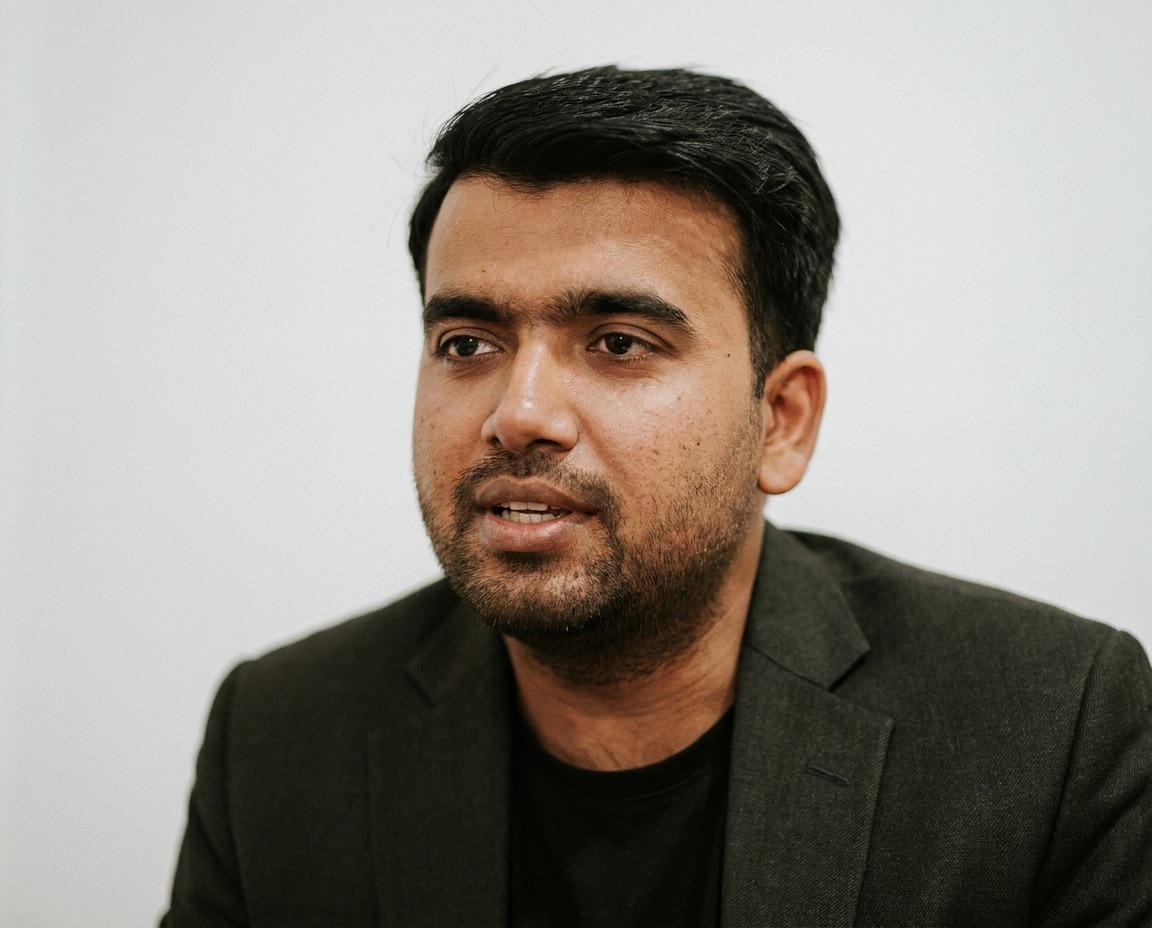
- Now
- English teacher at a school in Kashmir
- Before
- Teaching English and social sciences, with no formal training
- Studied
- English major at an interdisciplinary university, then a master’s
- Programme
- PgCTL, ten months
He was teaching English and social science with no formal training, unsure how to hold a class when students got bored. PgCTL gave him techniques such as exit and hinge questions, and he applied to one school in Kashmir and cleared every interview in one go.
Grade 8, without the alphabet.
Abdur Rehman Khan’s major was English, at an interdisciplinary university where he also took subjects such as astrochemistry and the sociology of pain and grief. At college he joined the university welfare club, and spent almost every weekend teaching children at a nearby government school or at schools in slum areas. Even in grade 8, students there could not tell the letters K, L and M apart. “They couldn’t write their names,” he says.
The volunteers had to come up with new strategies for students with “absolutely zero foundations”, and within a few months those students had started constructing sentences. During his master’s he worked as a teaching assistant, running tutorials for undergraduates. Teaching, he had realised, “gives purpose and meaning to my life and I enjoy the process”.
A call taken in the woods.
At the school where he went on to teach English and social sciences, some classes went smoothly. In others, he says, “the students would not listen to me and they would often get bored”. He had no formal education in teaching, child psychology or managing a class. In his third or fourth month at the school, he came to know about Suraasa.
He was going through what he calls an off-road cycling phase. He took his cycle to the woods and took his first scheduled call with a counsellor, who listened patiently to his background and what he wanted to achieve. “After that call I was very confident that maybe I should give teaching a try,” he says.
I can just engage them in an activity that they like and they automatically become silent. This is something that I learned from Suraasa.
Exit questions, hinge questions.
“Now when I can see that students are getting little bit out of control, I don’t have to shout,” he says. Instead, he engages them in an activity they like. He says he can now set differentiated assignments and modify his lesson plans to his learners’ needs, “in true sense, not just for the sake of saying it”.
Before PgCTL he had a rough idea that visuals sometimes make a lesson more interesting. Afterwards he knew “what the visual part does, what the auditory part does”, and how to bring the kinaesthetic into a classroom. He can also, he says, “very easily sense if the students are really grasping the text or not”.
This has been possible because of the various techniques such as exit questions or hinge questions that I learned in my PgCTL course.
One application, in Kashmir.
After PgCTL he was confident of a job at a school on his dream list. He turned down calls from schools in Delhi NCR, sure that better opportunities would come. Then an opening came up at a school in Kashmir, “a place where I always, always wanted to work”. He says he would not have known about an opening “in a remote corner such as this” without Suraasa, and credits the mock interviews for what followed. “They told me that I was their first priority,” he says.
His advice to current learners is to trust the process, be patient and talk to their peers and programme managers. Missing a couple of deadlines is “not the end of the world”, he says, though it is better to stick to them.