Abhijit DasIndia
Out of banking. Into a classroom.
Holding a classroom without raising his voice.
- Now
- About to start at a new school, back with middle-school classes
- Before
- Banking, then teaching in an IB school from 2017
- Programme
- Suraasa’s pedagogy course, taken four or five years into teaching
- Recently
- Grades 1 to 5 for the past two or three years
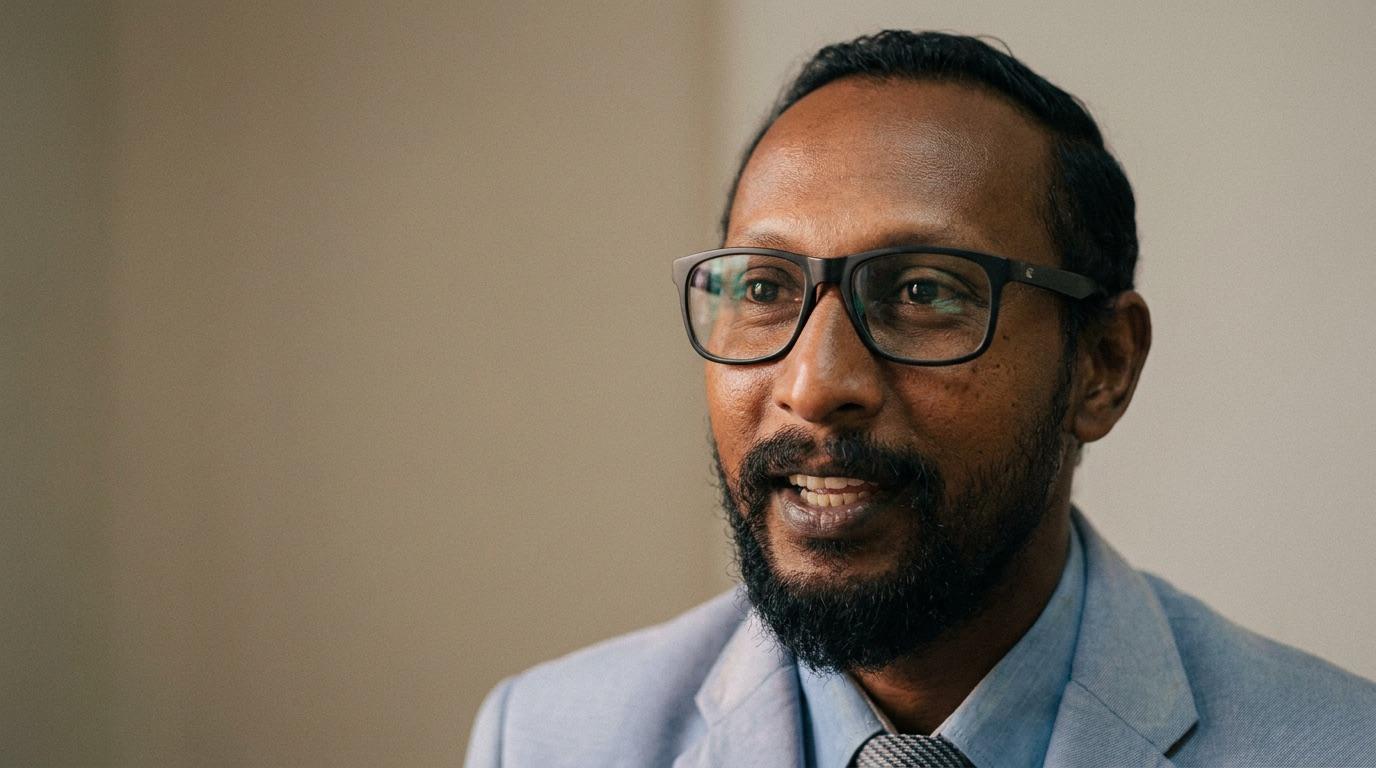
Abhijit came to teaching from banking in 2017 and spent his first years struggling to hold classes of thirty, and dreading the interview panel. He now manages behaviour without raising his voice, and is starting again with the middle-school age group he loves.
From a bank to a classroom.
Abhijit Das was a banker before he was a teacher. The move to what he calls “a new domain of work” was, he says, “not an easy task for me.” When he started in 2017 his classes ran from grade 1 to grade 8, with 25 to 30 students in each on average. “Maintaining that discipline inside the classroom was very challenging for me,” he says. “I don’t know how to handle those different age groups.”
“I remember the first two years I was struggling to manage my classes,” he says, and preparing assessments was not easy for him either. His school’s management supported him. Still, deep in his mind he believed he needed something more to handle the challenges teachers face every day. He was teaching in an IB school and held an IB certificate, but it did not fill the gap. “That tells about the philosophy of IB,” he says. “That never tells us those key aspects of teaching practices.”
Suraasa really gave me those advantages which really helped me to organise myself in a proper, in a professional manner.
Every day, something new.
He took the course after four or five years in the classroom. It covered planning lessons, assessment, giving feedback and classroom management. He had been looking for a way to touch “each and every key aspect of pedagogy, starting from lesson plan to the feedback giving and the follow-up process”, and to do it in an organised, systematic way.
He found each module interactive and engaging. “It’s not only just learning, learning,” he says. It was “how we can implement that in our regular teaching practices.” The assignments meant “getting deep into each and every topic and doing our research work.”
The biggest change he noticed.
When Abhijit talks about what changed, he starts with classroom management. “The biggest change: I don’t need to raise my voice,” he says. “I can make them understand. I can engage them into something else.”
The module taught him how to analyse behavioural issues, and about proximity as a teacher, explained in what he calls a very professional way. “We never knew about that,” he says. He now regards this knowledge as critical for a teacher. “If you don’t know those things, you can get into a trouble. You are inviting a trouble for yourself.”
The panel he used to fear.
Interviews were a separate worry. “I have that fear of attending interviews, sitting in front of that panel,” he says. “It was a big challenge for me.” He would wonder what questions were coming and how to answer them. “So I get very nervous sometimes,” he says, and he would end up giving wrong answers.
The employment module taught him to plan ahead. He learnt to research a school’s website, find its vision and mission statement, and tell the panel how interested he was in working there. He also learnt to follow up afterwards. “We expect them to contact us back, but sometimes it won’t happen,” he says. He now has a new school to go to, and says a few more opportunities came his way in between.
Back to middle school.
Abhijit joined his school in 2017 as a middle school teacher. After lockdown and an IB evaluation, he says, he had to step back, and for the past two or three years he has taught grades 1 to 5. The new job returns him to middle school, “which I love to teach”. He wants to start “from absolutely zero”.
His advice to other teachers is the rule he has set himself. “If you learn something and you are not using it, there is no point of learning those skills at all,” he says. And later: “Don’t give up your practices and skills.”
I can just implement those strategies and those methods whatever I learnt from Suraasa.