Ashwin James LalIndia
Practise the scenario. Not just the syllabus.
Practising the scenario, not just the syllabus.
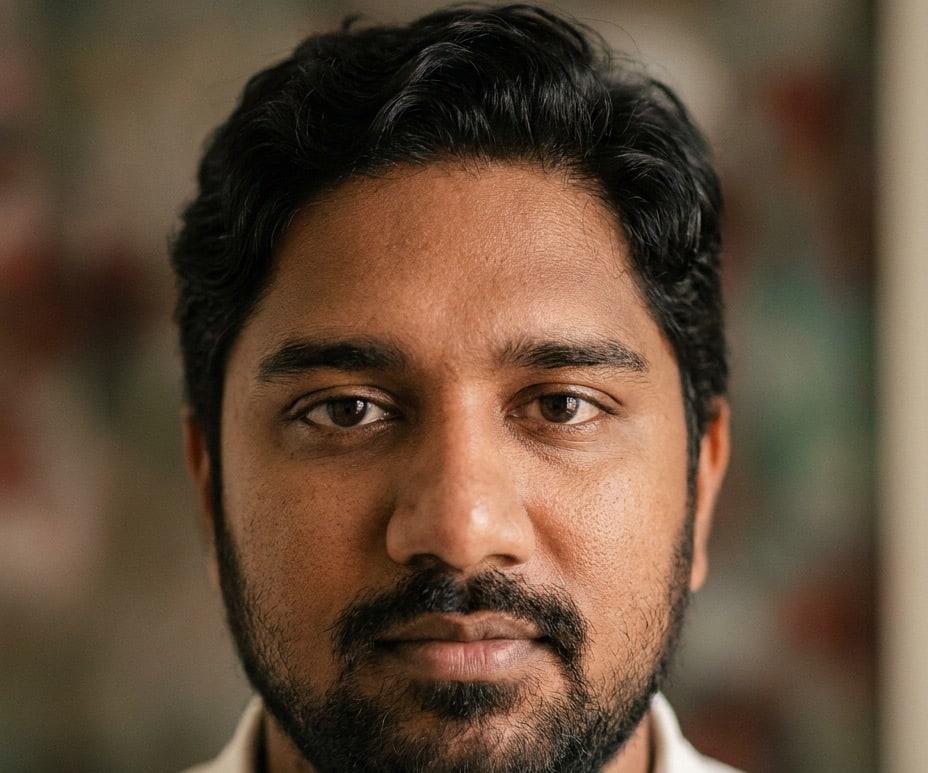
- Teaches
- World history
- First job
- A Cambridge and IB school in Gujarat
- Programme
- PgCTL, with every session online
Ashwin taught world history at an IB school in Gujarat, where training came as short workshops built around marking schemes and syllabus. PgCTL worked through scenarios instead, and the modules, assignments and feedback are still there to go back to when he forgets something.
What his own teachers did.
Ashwin James Lal calls PgCTL “more of a refresher”. He was an IB student himself, and much of what the programme covered he had already seen from his own teachers. “My teachers have been doing it,” he says, naming Bloom’s taxonomy and game-based learning. For him the programme was a way to “recap those things that I had seen in my IB days”, and again in his first job.
That job was at a school in Gujarat that ran Cambridge and IB programmes, so the teachers had to learn the methods that came with them. The training was workshops from the two boards. He does not dismiss them. “The IB workshops and Cambridge workshops are good,” he says. But they were “more to do with marking schemes and how to understand the syllabus”.
An example, then a quiz.
PgCTL, he says, “was more hands on”. He describes it as working from a practical question: “If this scenario happens, how do you deal with that?” He liked how the videos on the portal were put together. “Every term is supported with an example followed by, let’s say, a short quiz.”
The material, he says, is still there afterwards. “If you want to come back to it, it’s right there. It’s nicely organised. Your assignments are right there.” They have been checked, and the feedback is with them. It is a point he makes to his own students: “You can’t be a walking talking encyclopedia because at every point, you will need a reminder.” After years of teaching, he says, there are still times he has to go back to a fact he has forgotten.
He is direct about the conventional B.Ed in India. “They are good, no doubt, but I’m sorry, they are still not at par with the 21st century challenges.” He thinks PgCTL is “bridging that gap”, and that for anyone who wants to get into international teaching, it tells schools “you have some kind of an international training”.
The beautiful part is that even after you’re done with the course, it will stay with you, because sometimes you forget things.
Sunday afternoons online.
All of his sessions were online, and he admits that “sometimes online got boring”. He still learnt a lot about keeping a class interesting, because he was watching how the instructors did it. They found ways to bring people back to the class, whether that meant getting cameras turned on or getting people to participate.
Sometimes a session fell on a Sunday afternoon, when people were not in the mood to take part. Then, he says, the teacher “would somehow make the class so interesting or throw in a surprise game”. He has kept a few of those tips from how the instructors took their sessions, in case there is, “God forbid”, another pandemic situation.