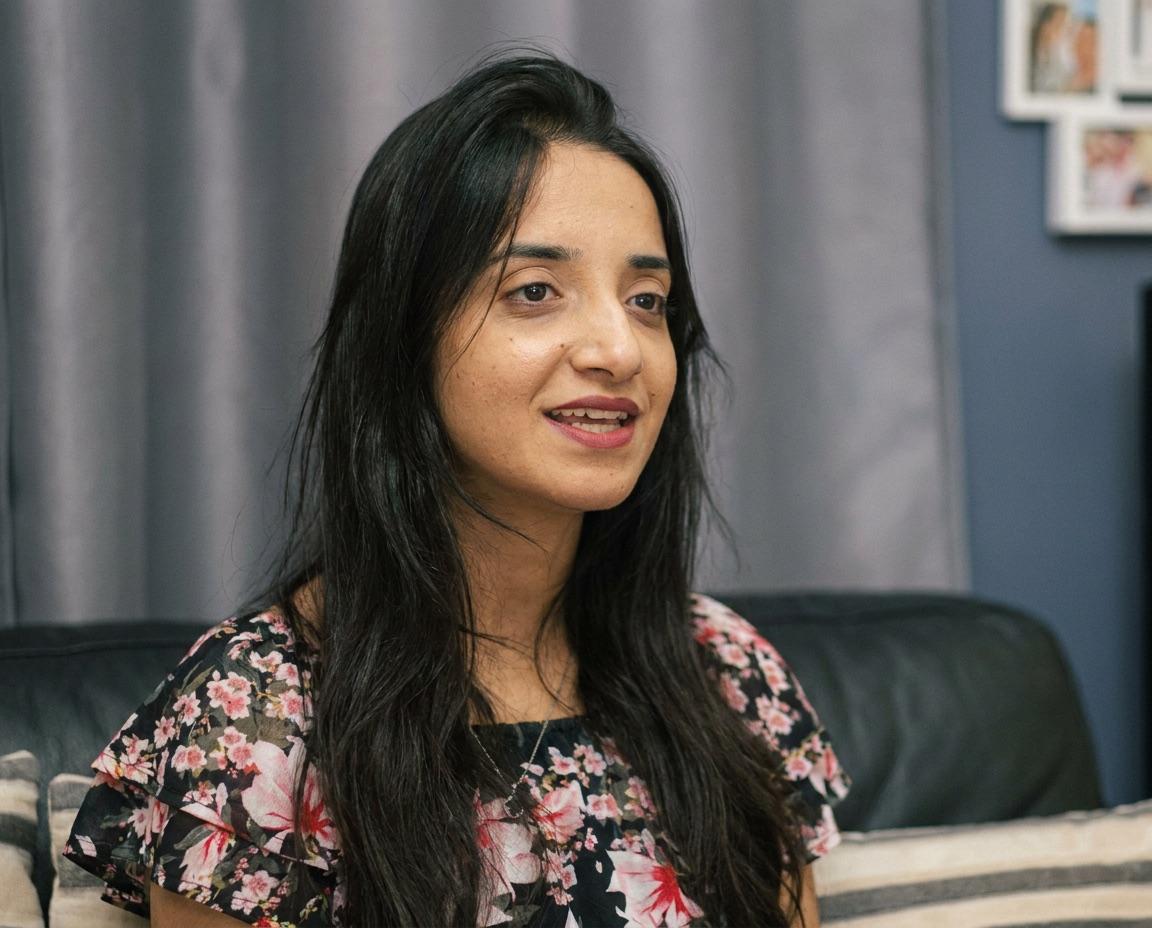
Karishma DodaniDubai, UAE
Doing it by instinct. Now by name.
Naming the strategies she was already using.
- Now
- English teacher and planner, Dubai
- Studied
- Master’s in English literature
- Programme
- PgCTL
Karishma had taught English in Dubai for years, using strategies she had picked up by instinct without knowing what any of them were called. Naming them, and the theory under them, gave her the confidence to change schools and take on a planner role alongside her class.
The theory under her lessons.
Karishma Dodani, who holds a master’s in English literature, starts from what teachers already do before any course. “We as teachers do a lot in the schools to understand our learners,” she says. “We create an environment where we cherish each child as a unique child.” What PgCTL added was the learning theory underneath that work.
Under behaviourism, she learnt “how environment and conditioning plays a vital role”. Constructivism and cognitivism, she says, are what she applies in her lessons most of the time, building new knowledge on prior knowledge. She connects topics to the real world because students experience it and remember it for the long run. Her classes are virtual during COVID, and she now connects her topics to COVID time. “I could see how beautifully students connect themselves to the outer world,” she says.
By getting into the course, I learnt about different learning theories and teaching strategies which I pretty much did not know the correct term for.
Data through the year.
Her use of data changed as well. “I have been evaluating and analysing the data to understand my learners,” she says. “I do it often throughout the year instead of just doing it at the end of the year.” She has also worked with the feedback she receives from parents.
The strategies she lists are specific: chunking, reflection time, think-pair-share and exit tickets. Her classes use virtual resources such as Socrative, Padlet and graphic organisers, which she says support the VARK theory and support learners in different ways. Differentiation, in her experience, can be handled easily “if done well and in a proper method”. “I differentiate in terms of content, process, product, environment so that each and every child feels motivated,” she says.
A new school, a planner role.
The confidence showed when she moved. “When I plan to switch to school I was more confident and was evident that I have worked on my skills,” she says. The programme, in her words, “headed me towards a planner role”, and she now works as an English teacher and planner.
She is glad to have studied child development in depth, and is “looking forward to continue learning as well as rising”. She enjoys her profession completely, she says, and once she is home she gives her full attention to her personal life.