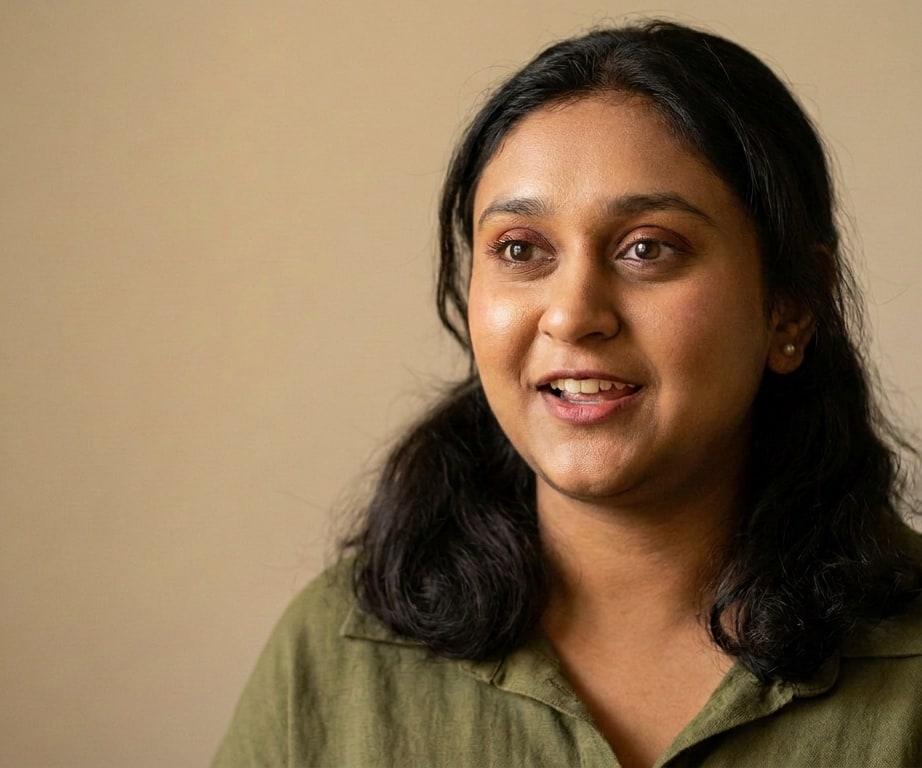
Meenu A SGEMS Legacy School, Dubai, UAE
Physics without fear. Now in Dubai.
Taking a fear-free physics classroom to Dubai.
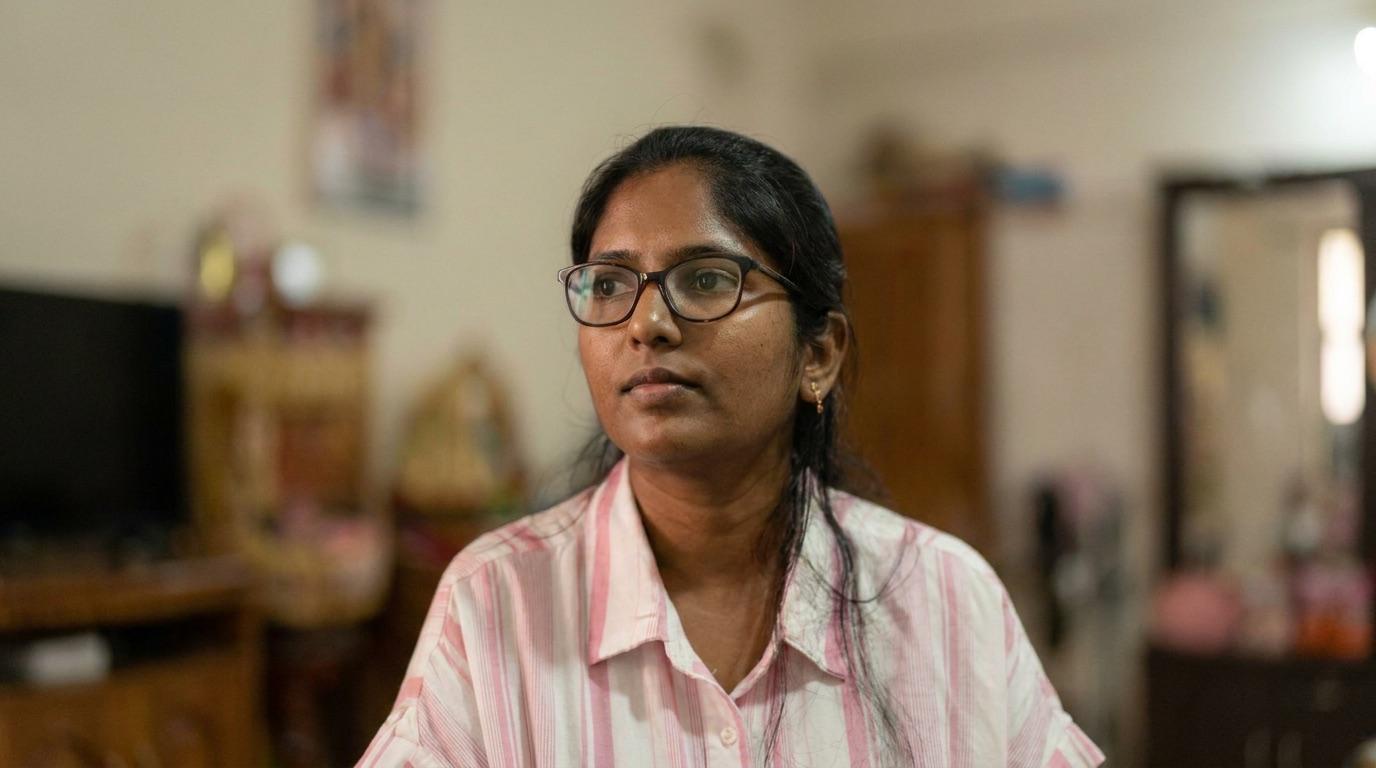
- Now
- Placed in a TGT position at GEMS Legacy School, Dubai
- Before
- Grade 10 physics teacher from Tamil Nadu, with master’s degrees in physics and education
- Programme
- PgCTL, with weekend live classes and modules after ten at night
- Next
- PGT or head of department
Meenu taught grade 10 physics in Tamil Nadu, where schools treated her simulations and smart boards as a waste of time and no clear route abroad existed. Demo interviews and employability sessions prepared her, and she is now placed at a school in Dubai.
A whiteboard nobody could see.
Meenu A S did not set out to teach. She finished a master’s in physics around 2019 and was planning a PhD. She had cleared the GATE exam, she says, but could not get into the institutions she wanted. During lockdown she began tutoring students online who were preparing for competitive exams.
“I still remember my first class. I don’t know how to take the class,” she says. “I was like a complete blank slate.” She wrote on a whiteboard behind her, and the students could not see it, so she wrote notes and shared them on WhatsApp. She moved to PowerPoint and tried writing with the mouse. “It was very difficult.” Then she learnt about writing tablets and began using one.
Because she erased each session’s writing and had no backup, she started making a PowerPoint for every class, with small animated characters on the slides. When a student gave a correct answer, a smiley appeared. If she had ten problems for the day, they asked for five more.
Two minutes against two pages.
Most students, she says, are scared of her subject: “Oh my god, physics, I’m not going to understand the concept.” During the lockdown she had started using simulations. Reflection was one topic students could not visualise. Once she showed it that way, they called it an easy concept. She recalls them saying: “You have said it very easily using a two minutes tool but the book has written for two pages.”
She was teaching grade 10 at the time, and reasoned that a strong foundation there would carry students through the tougher concepts of grades 11 and 12. Not every school welcomed her methods. In a few, she says, the message was “no need to do so much of things. Just teach them the concept.” She also wanted career growth. She looked at Singapore, Malaysia and the US, found that moving directly from Indian experience “is not that easy”, and went to Suraasa for help.
Four hours, undisturbed.
She had seen people go abroad for higher studies, or with IT companies, but had not met anyone who planned to move abroad in order to teach. In PgCTL she came across a lot of teachers with that dream. In the live classes, teachers of different subjects would talk over what was happening in their schools and how it could change. As someone who had only recently started teaching, she liked hearing senior teachers tell her there was a simpler way to do something.
The live classes fell at the weekend, when family responsibilities might have her out of the house, and she would rush home to prepare. Her family had instructions: “Next four hours, you can’t disturb me. You can’t call me. You can’t ask me to do anything.” The self-paced modules went into her free time, which she says was usually after ten at night, or two free periods in a row at school.
One very great thing which I like with Suraasa classes is the group discussion time.
The same test for everyone.
Before, she says, she did not use different assessment strategies. “For everyone I used to give the same test.” Her thought on hearing about differentiated instruction was, “Why can’t I implement this in my classroom?” Once she did, she could see how a particular student was struggling, and she made changes to her teaching strategies.
With a master’s in education, she was already familiar with some of what was taught. What she took from the faculty was how to work smarter, for example by putting a lesson plan into a proper structure. These “small changes”, she says, made her work much easier.
I learnt a few interesting things like differentiated instruction, which was taught… in our first session. That’s how I started doing that in my classroom.
Placed, and looking past it.
The employability sessions included two demo interviews, with general questions rather than subject-based ones. They helped her work out how to improve her answers and be more confident in front of an interviewer. The module took time, she adds: almost four months to reach the end of it.
She has been placed at a school in Dubai, in a TGT position, and has not fixed how many years she will stay. Her two aims for now are to learn from the school and to help the people around her. After that she wants to move up, to PGT or head of department.
Her advice is to be clear about the reason for taking a course. She has seen people expect to become, in her words, “a millionaire in a year”. “You should first focus on the learning of the course, what you’re going to take from the course,” she says.