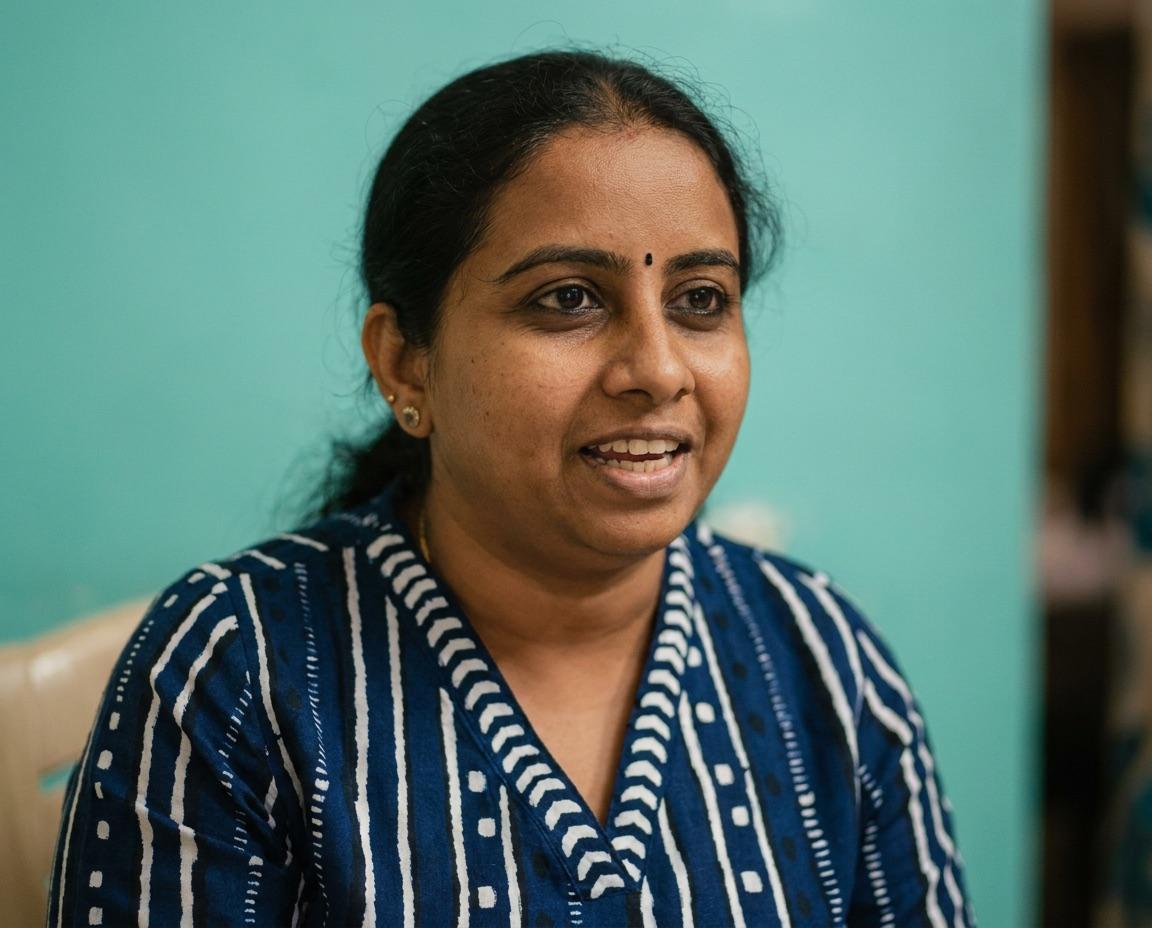
MonishaBihar, India
Nearly quit. Now leading academics.
Coming back from the night she nearly quit.
- Now
- Academic coordinator at a school in Bihar, teaching English and science
- Before
- Biotechnologist in Qatar and the UK, then a teacher from 2014
- Programme
- Suraasa’s ten modules, recently completed
- Next
- Schools abroad, in countries like Ireland and the Netherlands
Middle-school students in a city school told Monisha they did not want an English teacher, and that night she told her mother she would quit. She is now an academic coordinator in Bihar, where giving structured feedback has changed how she and her colleagues teach.
A chat with her mother.
Monisha started teaching in 2014, with primary classes, and found it easy. “I felt it was a cakewalk,” she says. It was a time, she says, when “kids wanted only love”. Then, in 2016, she moved to a school in a metropolitan city and was given middle school students.
“They literally told me, I think we don’t want an English teacher,” she says. “I had to listen to this.” The person she turned to that night has been in the profession for 25 years and is now a headmistress. “I still remember having a chat with my mother, telling I’m gonna quit.”
Her mother was the reason she was teaching at all. Monisha began as a biotechnologist. After her master’s she spent a year in Qatar, then worked in the UK as a pharmaceutical biotechnologist. Home on vacation, she was tired. “I wanted to interact with kids. I wanted to interact with people. In lab, it doesn’t happen.” She remembers her first visit to her mother’s school: “When you enter into the classroom, it’s all totally a different world.” She took a B.Ed, a one-year course at the time, gave home tuitions alongside her biotechnology job, and got the chance to replace a teacher at a school for six months.
Three sets of students.
She married in 2020, in the middle of the pandemic. Her husband is an army officer, and she joined an army public school. It was unlike the schools she had known, where the work was to complete the syllabus and the assessments. “You don’t have to be a teacher there. All you have to be is a facilitator,” she says.
In class she saw three sets of students: those who did not behave well but were good at their studies, the average, and the below average. “How can I help? I don’t know. I didn’t know.” She could help them with debates, elocution competitions, dramas and monologues, and she was not satisfied with that. For her, English teaching is about how well a child can “portray himself in front of the world with confidence”. She felt she was failing somewhere, and she took a break. She was scrolling Instagram one day when she came across Suraasa.
What more could it give.
Her family had doubts. She already had a B.Ed, and they asked what more an online platform was going to give her. A friend, one of her senior teachers, had done the programme and made her a promise: “You will come back to me, Monisha, telling that thank you so much for introducing me.” She enrolled in a sceptical mood herself. “Honestly, I walked into the programme saying, OK, what more? Let me just explore.”
The first module was on what she calls the “different isms”, constructivism and behaviourism among them, and she found it overwhelming. Even so, that very first session changed where she looked for the problem. She does not pretend the rest was light. She describes all ten modules as overwhelming, done alongside work, with back-to-back assignments.
It was not the performance of the students. It was the reinforcement that the teacher had to give.
Feedback, in a small town.
One module she holds close is the one on assessment and providing feedback. “Providing feedback was never on the pages of my book,” she says. Her first reaction was to ask why a teacher would give feedback at all. It sounded to her like something from the corporate world.
She now holds the position of academic coordinator at her school in Bihar, in what she describes as a very small town. When she and her co-teachers started providing feedback to students, she says, “we could find a great change, a very good change”. She takes it outside the school too. When she goes to talk to and encourage other teachers in the town, “the first thing I always talk about is providing feedback”. In Bihar, she says, Suraasa helped her establish a lot of new things at a school “where it needed the most”.
A school from the Netherlands.
She has just completed her modules and is looking outside India, at countries like Ireland and the Netherlands. She expects an interview with a school from the Netherlands in a couple of weeks. Clearing it or failing it is not the point, she says. “It’s more about how much I have learnt, and what more to learn.”
She is open about the doubts. “I hit an age of 30 plus and you have a lot of self-doubts. You don’t know where to start, where to go.” What she says she learnt from her favourite professor on the programme is simple: “It’s OK if things don’t work, but keep learning.”
What I have understood through Suraasa is you don’t have an age to learn. There is nothing that is going to stop you from learning.