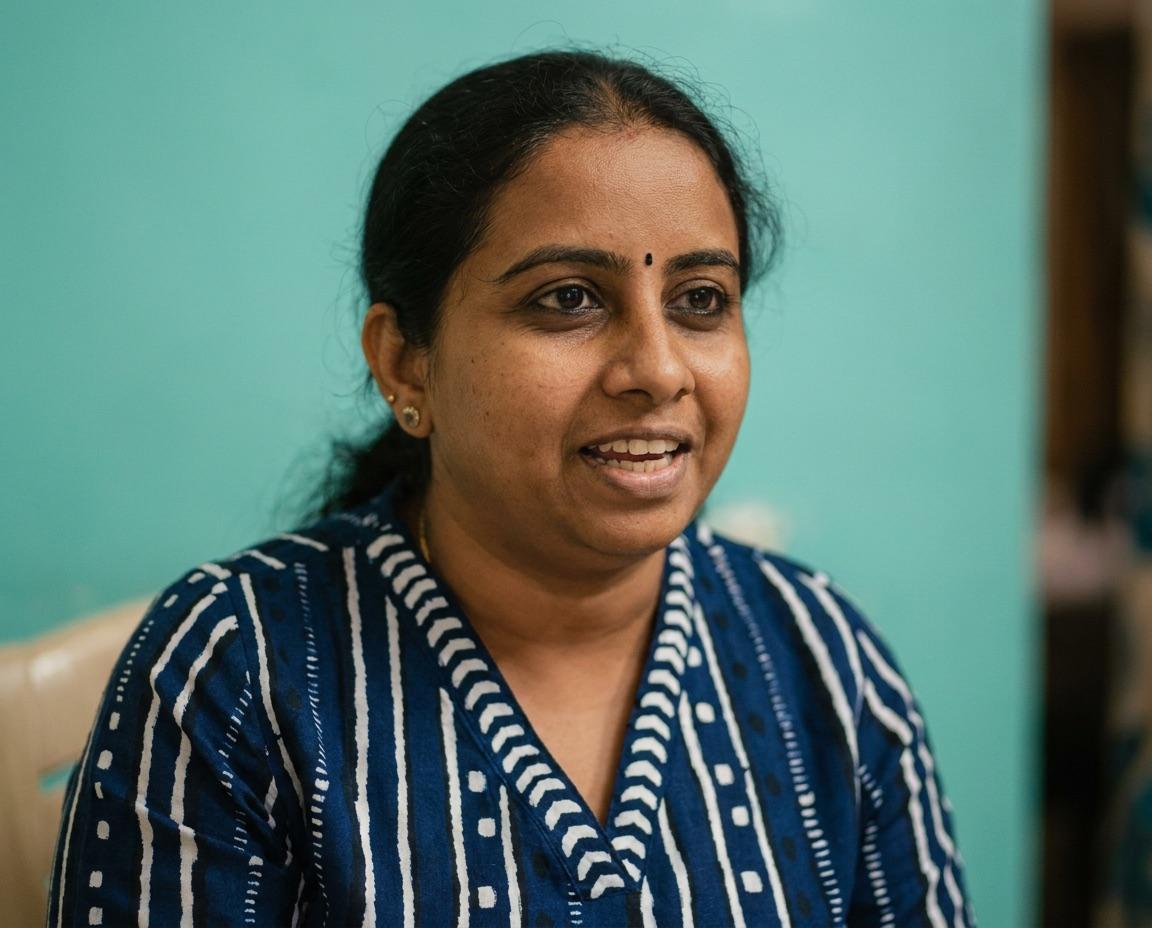
Neha TickooIndia
Forty students by day. Recording at 2 a.m.
Teaching from theory, not just from instinct.
- Now
- Mathematics subject matter expert at an edtech company, working from home
- Before
- Schools and a polytechnic college from 2009, then a problem-based learning school
- Programme
- PgCTL, in progress, alongside work and a toddler
- Next
- Progressive schools in her city, or schools in Dubai or the US
Neha had been teaching since 2009 and had heard about differentiated instruction for years without ever using it. Midway through PgCTL, while raising a toddler and building maths content for an edtech company, she now plans each lesson around a theory and differentiates by content, process and product.
Recording at 2 a.m.
In 2023 Neha Tickoo went back to work after a year away, but not to a school. She joined an edtech company as a subject matter expert, working from home, creating and recording content. The pedagogy was different again: chunking and scaffolding problems, aimed mainly at average learners, “so that they can understand mathematics better”.
She also had a small child at home. Her team was supportive and the hours were flexible, so she created content while the child slept, or found an activity to keep the child busy. Classes had to be recorded too. “Sometimes I had to record it at 2 a.m. in the night because my child never let me do it in the daytime,” she says.
Forty students, one teacher.
Neha had tutored students at home while she was still studying herself, and says it was always in her mind that she would teach. She started in 2009, after a master’s in electronics, took a B.Ed along the way, worked in several schools and lectured at a polytechnic college. Most of those schools, she says, were conventional. “There was no experimentation.”
In one school the ratio was almost 40 students to a teacher, and she was teaching grades 10, 11 and 12 while young herself. Classroom management was hard. What she learnt, gradually, was that adolescents will not learn from someone who only commands. “You have to be a friend. You have to be among one of them. Then they will listen to you.”
After almost nine years she moved to a problem-based learning school, where she got exposure to differentiated instruction and inquiry-based learning. When the pandemic came she was not used to Google Meet or Zoom. She learnt them, along with Google Classroom and Padlet, and her students began presenting their project work digitally. “They were telling us, ma’am, we can do this way also.” The school named her its most innovative teacher in technology.
A break, and an Olympiad.
She left her job in 2022, when she was expecting her child. She kept taking digital courses and attending webinars, and it was then that she came across Suraasa, through its International Teachers’ Olympiad. She entered and was in the top ten percentile. “I really felt good that at least I’m somewhere, I’m doing something good,” she says.
PgCTL stayed in her mind after that, but she could not decide. The hesitation was simple: “It’s difficult to pursue any course when you have a toddler at home and you are even working.” She had also wanted to do an M.Ed for a long time. This time she wanted something she could apply, in the progressive schools she hopes to move to, rather than theory learnt only on paper. “We are just reading and reading and writing the papers, giving the exam, that’s all.”
Nothing to copy and paste.
Her B.Ed, she says, “was all theoretical”. Professors handed out study material, and she found the answers in it and copied them into a notebook for submission. PgCTL did not work that way. “You cannot copy paste anything from anywhere. You have to use your understanding.”
The assignments were not only written. One had to be a presentation explained on video, another a blog, another a podcast. “I had no idea about podcasts. I had no idea about blogs,” she says. The first module was on assignment writing itself, with referencing and in-text citation, which she expects to teach her own students later.
It did not start well. “Honestly speaking, my first assignment was a disaster,” she says. She had spent about 15 days on one assignment. She reattempted it, went to the guiding sessions whenever she had a question, and says she has not repeated those mistakes since.
You’re going into the classroom and delivering the lesson plan, somebody’s observing you, you’re then reflecting on your work, how you can make it better.
A theory behind the plan.
She started with learning theories. “Even after working in problem-based learning school, I had no idea about those theories and how to apply those theories in the classroom,” she says. Writing a lesson plan afterwards was, in her words, a different experience. She was keeping in mind which theory she was using, which group of learners it was for, and how it would benefit them.
She hopes to complete PgCTL this year. After that she plans to apply to schools through the Suraasa portal, abroad in Dubai or the US, or in the progressive schools of her own city. “I’m upskilling myself for this only, so that I can teach at a better place and get paid well, of course.” She does not hide the workload. “Yes, it’s time consuming. You have to put a lot of efforts. But yes, good things take a lot of time.”
This course has given me a clear insight about the teaching approaches, teaching theories that we can apply in the classroom.