Priyanshu MalikDubai, UAE
Speak less. Let the class lead.
Speaking less and letting the class lead.
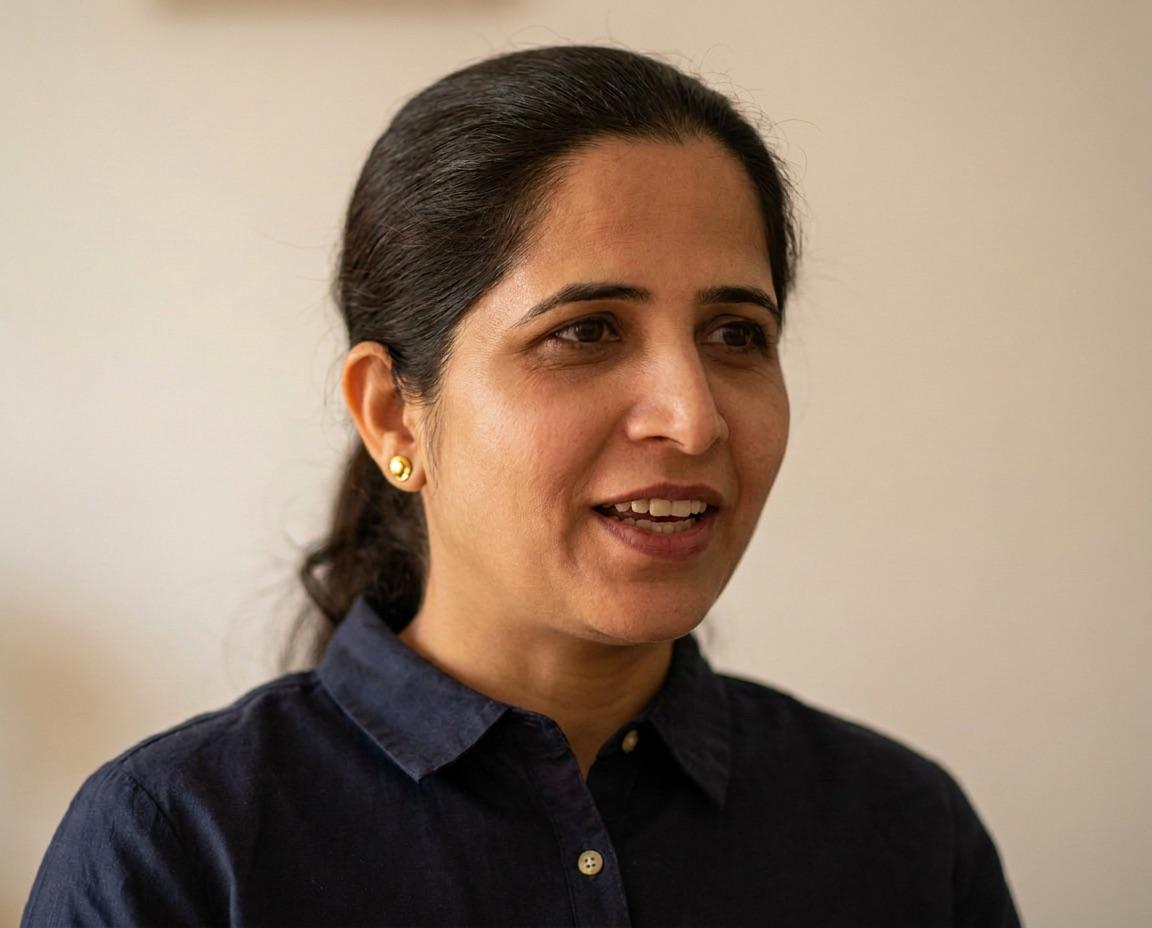
- Now
- Middle and senior school teacher, Dubai
- Studied
- B.Ed and M.Ed
- Before
- Turned down by an O level school for lack of experience with its curriculum
- Programme
- PgCTL, suggested by a friend
Priyanshu cleared every panellist at an interview in Dubai and was still turned down, told she did not know their curriculum. She learned to plan for progression against it, and now barely speaks in her own lessons while her students show what they can do.
One line of feedback.
“Being a double master’s, I was thinking that my thinking level is very nice,” Priyanshu Malik says. Her academics were very strong. She had come to Dubai with offer letters in hand, all from Indian-curriculum schools, and was choosing between them. She also interviewed at a school teaching O levels. “There were seven panellists. I cleared all seven panellists, but I didn’t get selected.”
She asked why, and got the single line about the curriculum. She was not expecting it. She describes herself as “broken from inside”, and says, “It was a trauma for me for a while.” She kept thinking about why it had happened and went to many friends. One of them suggested the programme to her.
The answer she has now.
“Today I know the answer, why they didn’t take me,” she says. “The approaches what they were asking me, I was not able to answer.” In the UAE, she explains, an interview or a demo class looks for exactly what the KHDA looks for in a classroom, and the panel is searching the teacher for those qualities.
Theory was not the gap. She had studied the educational theories during her B.Ed and M.Ed. “I was pro in them,” she says, and she scored very good marks. “But where I was lacking, I was not able to implement it in the class properly.” She is careful to say she is not criticising her university, which she calls one of the best. What her degrees had not given her was practical experience. The faculty, she says, helped her think about how to implement those theories in class.
A question she could not answer.
What the KHDA wants to see, she says, is progression. “If the progression is not there, means that your class is not up to the mark.” She thinks in Bloom’s levels. A lesson that starts at understanding should bring students at least to analysis, and then on to higher-order thinking. The plan has to follow from the class’s own data. “Then only your class will become interactive.”
She remembers one planning task from the programme. The group had planned a lesson, and in between the professor asked a question she has not forgotten: “Do you think that your students are going to the next level?” She says, “At that time I was not having any answer.” Now she has one, and can explain it. “Yes, I’m taking my students to the next level.”
Six to ten sentences.
The KHDA, she says, does not want teacher talk. When she was a student, classrooms were teacher-oriented. Now no school wants that. “The classrooms should be student oriented, where the students are actually showcasing their learning,” she says. “We know our content is strong. That’s why we are in the school.” She tells teachers joining the programme that the faculty will drill the student-led class into them: “You yourself will speak only six to ten sentences in the class.”
When the KHDA inspection is going on, sometimes I think I hardly speak five to six sentences and rest the students’ work is being showcased.
No longer panicking.
The word observation used to put her, as she tells it, “in a panicking situation”. Recently someone told her she had an observation that day. “I said yes,” she says, and she was told how relaxed she looked. She has lost count of what came after the programme: “I don’t even remember how many outstanding lessons I have given after that.” When visitors come from outside and the school has something to showcase, she says, her name is there for her subject.
You look very chill. How come? So that’s the confidence you get when you are doing something with Suraasa.
Sometimes bumpy, sometimes smooth.
She does not pretend it was easy. She calls the programme “a roller coaster ride”, sometimes bumpy and sometimes smooth, with the faculty pressing her to “do it, do it, do it”. She still enrols in masterclasses when the message arrives. “Sometimes I’m not able to attend,” she admits, but there is a recording. “The hard work is there, yes, you have to give your time.”
Her day is complete, she says, the moment she gets appreciation from her students, and she does not think that takes being “very goody-goody” with them. She scolds them sometimes. “They say, ma’am, yesterday you scolded us very badly,” she says. “But this is what they are expecting from you.” She has a phrase for the job: “We are the second parents of our students.”